Gemma Correll gets me.

gemma correll introvert heartIt’s no secret that I’m really an anxiety-flavored bag of blood that walks around on two large feet. I can’t help it—worrying is in my nature. It’s something that informs every major life decision, but probably holds more sway over the small stuff. It’s why I own so much bedding (so I can stay in bed all day, of course, and never see people) and why I insisted on getting another dog, even though one is probably enough (no, it’s not—I need all the animal companions in my quilt-covered paradise).

But artist Gemma Correll gets it. She recently released a very funny book of comics called The Worrier’s Guide to Life and I’m totally smitten. She makes fun of student loans, Valentine’s Day, those freaking “Keep Calm” posters—ya know, the big stuff. It’s great. I love comics, though not the action hero kind. I prefer Kate Beaton’s brand of brilliance to Batman’s stumbling ineffectiveness.

And while I’m listing awesome female artists, check out Hallie Bateman and Esther Werediger. From the comfort my horizontal workstation, I online-stalk them both.

Pencils are trendy.

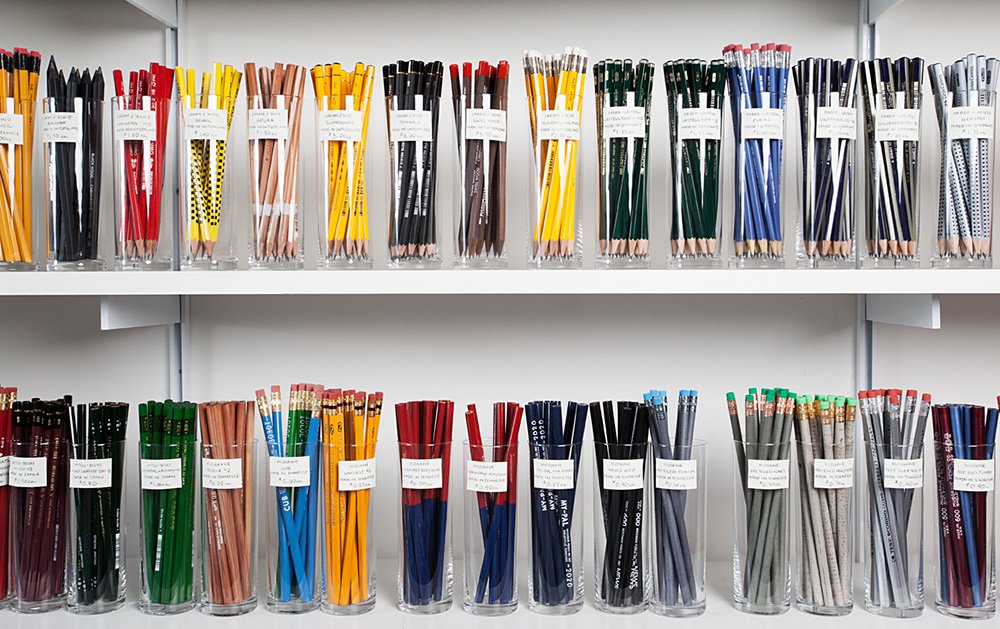
pencil shop cw pencilToday in hot trends: the humble pencil! Here’s my evidence:

1. The hilarious/absurdist Artisan Pencil Sharpening skills of David Rees, who offers his service by-mail from his home in the Hudson Vally. Because… why? Who cares. It’s funny. (Here’s David Rees chatting with The New Yorker.)

2. An exhibit called “The Secret Life of the Pencil” opens in London this week featuring photographs of the writing implements of famous artists, writers, and designers. Dying to know how Dave Eggers sharpens his pencil? I wasn’t either, but I clicked on this link and read the story anyway.

3. A pretty young hipster lady in New York City has opened a store called C.W. Pencil Enterprise which sells (you guessed it!) pencils. She has a tattoo of a pencil on her forearm. Her store has been described as intoxicating and charming. Then there’s this: “Her store is the size of a juice box, with a checkered floor and jars of yellow button chrysanthemums sprinkled around. With its spanking newness and luminous blocks of color, the place looks like an Edward Hopper canvas.” It sounds terribly twee and yet despite my cynical whining I still really, really want to visit!

Pencil, I’m so glad you’re finally getting your moment in the limelight (after being No. 2 so long to the pen). (Ugh sorry, I seriously couldn’t help myself.)

Great words in graphics and what I learned from kid writers.

Minimalist word poster by Mick WatsonI say this all the time, but teaching writing is one of the shiniest, happiest parts of my life. I work with the wonderful people at The Telling Room, a nonprofit writing center located in downtown Portland, Maine. I haven’t been teaching for too long, but I’m learning quickly how difficult it can be—but also how rewarding.

One of my favorite things about teaching writing is seeing how kids use language. They go crazy with it! They can be free and funny and break all the rules. It’s like how Picasso said it took him four years to paint like an old master, but a lifetime to learn to paint like a child—there’s something to be said about un-learning things, throwing education out the window, and thinking like a child.

But while my students may have a leg-up when it comes to sheer inventiveness, here’s one thing I have on them: Vocabulary. Kids simply haven’t learned all the beautiful, specific, melodious words that English can provide. Which is where these super cool minimalist posters come in. To address the vocabulary question, a graphic designer from Edinburgh named Mick Watson created a series of posters that depict complex words in simple graphics. “I was thinking about my 9-year-old daughter’s expanding vocabulary and wondered that if I made some posters with a visual hook and put them up around the house whether she’d pick them up,” Watson told Slate writer Kristin Hohenadel. “She was being a contrarian at the time so I started there!”

Watson’s list includes some of my favorite words, like petrichor and deasil. And I admit, I learned a few new words looking at his designs! See more of Watson’s Word of the Day project online here.

Language is awesome: Regional slang from around America.

illustrated map of the USADo you know what a skimmelton is? What’s a “cascade” in North Carolina? Or larruping? Or what about a woopensocker? NPR published a hilarious list of regional slang from around the USA and I’ve never heard of like 80% of them. But whoa! Colorful language.

I learned how to be a girl from Mary Karr.

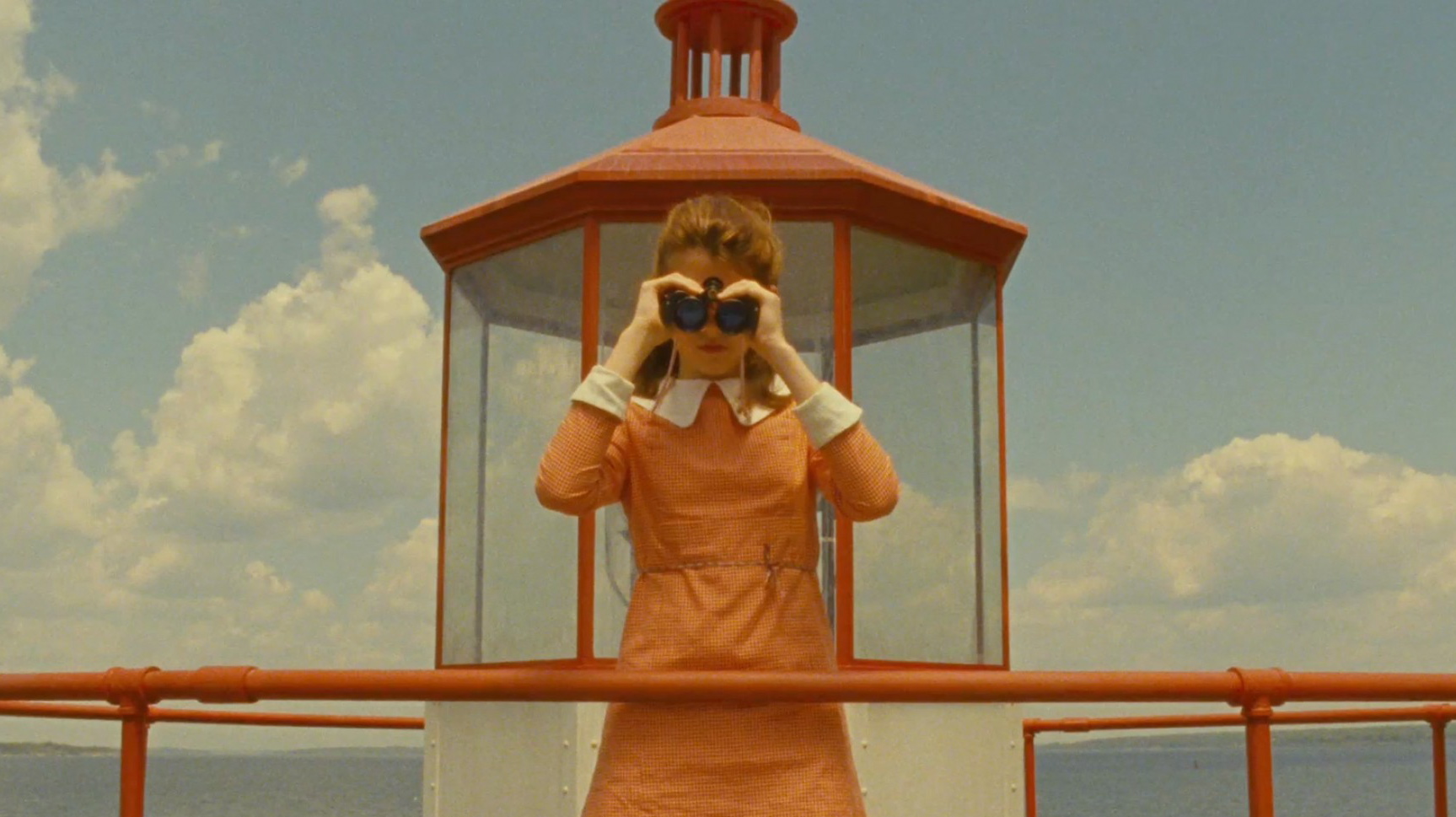
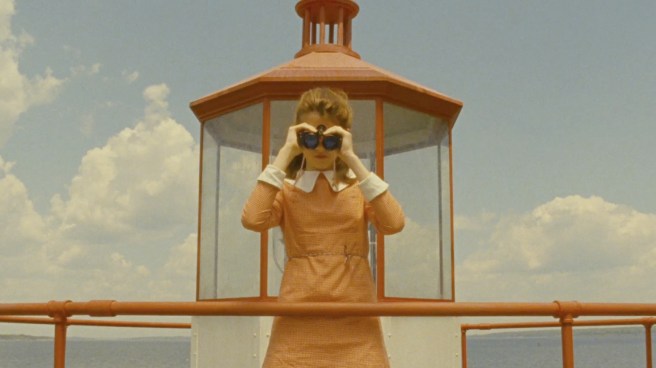
moonrise-kingdom-04When I was 12, I stole Mary Karr’s first memoir, The Liars’ Club from my dad’s office and read it all the way through in a day or two. I remember rushing through it, gobbling it up like Melville with his oranges, hungry for every detail, thrilled by every disaster. I read it under the covers late at night as my sister slept in our shared room, snoring her little-girl snores and muttering in her sleep. I hated that I was the older sister—kid sisters, it seemed to me, were always more fun. Karr certainly was. Younger sisters had someone to teach them how to be a girl, someone to emulate. I had only books and a nerdy older brother, who taught me how to make chain mail, but not how to apply eyeliner (hence my early forays into makeup were rather unfortunate).

Some might say I was too young to be reading Liars’ Club (like my dad, for instance) but I think I read it at exactly the right time. That book gave me permission to be a little bit bad. And her next memoir, Cherry, taught how to be a teenager, how to be a tough little beast who takes a beating and gets right back up.

Karr continues to teach me how to live through her graceless mistakes and graceful language. Here’s an excerpt from an interview with Karr in The Paris Review: 

KARR
You have constantly to question, Is this fair? No life is all bleak. Even in Primo Levi’s camp, there were small sources of hope: you got on the good work detail, or you got on the right soup line. That’s what’s so gorgeous about humanity. It doesn’t matter how bleak our daily lives are, we still fight for the light. I think that’s our divinity. We lean into love, even in the most hideous circumstances. We manage to hope.

INTERVIEWER
But we remember the bleakness.

KARR
That’s mostly what we remember.

I’ve read this interview several times over, and each time, I learn something about being in the world and writing to it.

Anyway, if you haven’t read Liars’ Club or Cherry, they’re both wonderful books. Cherry is the story of her high school years. I read it when I was in high school myself and it was so refreshing and real. It felt like someone I knew was talking to me, telling me that it’s all going to be okay. I wish schools taught Cherry instead of Catcher in the Rye. Boys that age could use a little female perspective once in a while.

Why I read, why I write: Making jewelry for the inside of your head.

Ellen_Jewett_Turtles

My work is incredibly important to me personally. It brings me joy and it brings me life and it brings me meaning. It doesn’t necessarily have to be important to the people who read it. It would be nice if it did bring them life and meaning, but it doesn’t have to. It’s not their fault that I wanted to be a writer. I just want to do it because I like doing it and it’s a pleasure. I always quote Tom Waits, because I had this amazing experience of getting to interview him and every single thing that he said was so Socratic—he’s just biblically wise about the arts—and he said something like, “You know, it’s not that important what I do. I’m just a guy that makes jewelry for the inside of people’s heads.”

OH GOD Elizabeth Gilbert nails it, all of it, in this very long, very wonderful interview with The Rumpus. Most people know her from Eat, Pray, Love and  many “serious” writers and readers tend to dismiss her because of the chic lit nature of that particular book. But she’s so much more than that! She’s a wonderful nonfiction writer (The Last American Man is one of the most fascinating true stories I’ve ever read) a sharply funny fiction writer (Pilgrims, her short story collection, is also worth a read) and one of the best TED speakers ever (seriously, go watch this right now—it’s awesome).

I’ll stop fan-girling now and stick to the facts. Fact: Elizabeth Gilbert makes me feel better about getting rejected, because that’s just a fact of writerly life. Fact: Elizabeth Gilbert recognizes the value of hard work and fights against the whole idea of genius, a toxic concept that’s killed plenty of genuine creativity. Fact: Elizabeth Gilbert also recognizes that writing isn’t truly that important. It’s not! It’s a wonderful thing to read and a wonderful thing to write, but it’s not the be-all-end-all. It’s one way of addressing the existential despair and the turtles-all-the-way-down nature of the unknowable universe but it’s not life or death.

And, once you recognize that slightly uncomfortable fact about our work, there’s no excuse for not having some goddamn FUN with it.

Above image: sculpture by Ellen Jewett, a Canadian artist who creates fantastical and otherworldly animal pieces.

The ultimate mombod.

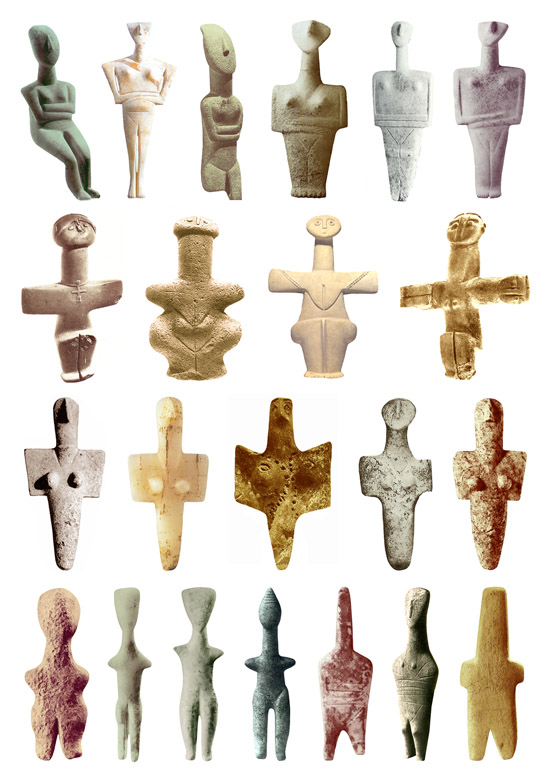
great mothers of the stone ageIn honor of Mother’s Day (and since my mom reads my blog more than anyone else, probably) here’s a very cool graphic of mombods compiled by the smart ladies at etsi-ketsi. (Don’t know what a “mombod” is? It’s cool, it’s a stupid made-up thing that happened on the internet.)

It’s also interesting to note that these aren’t all Stone Age sex symbols as some might assume. “Erroneously, perhaps even cynically, many of the statues and sculptures shown here have been named Venus statuettes by patriarchal archeologists, as in Venus of Willendorf and Venus of Laussel; names based on the well-known nude depictions of the much later and slender Roman Venus,” explains scholar Eva Sawada.

Here’s another amazing graphic, this one shows “Goddess Sculptures” from the early Bronze Age. There’s something so amazingly modern about these, so geometric and cool, especially the top row.  With their sharp angles and big shoulders, these femmes remind me of 80’s business ladies in power suits. How would you worship a boss-bitch goddess? By burring a pyre of vintage Vogues? By using lipstick as warpaint and reenacting the ancient ritual of the power lunch? By sacrificing your toes to the torture of a pointy heel? One can only imagine. goddess sculpturesAnyway, happy Mother’s Day or whatever. Enjoy the history lesson.

Things that I wrote: A Dress to Die For, published on The Hairpin.

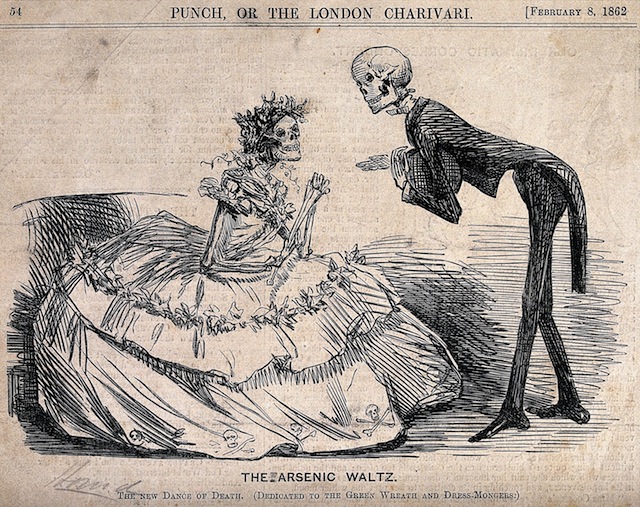
V0042226 Two skeletons dressed as lady and gentleman. Etching, 1862. Credit: Wellcome Library, London. Wellcome Images images@wellcome.ac.uk http://wellcomeimages.org Two skeletons dressed as lady and gentleman. Etching, 1862. 1862 Published: February 8, 1862 Copyrighted work available under Creative Commons Attribution only licence CC BY 2.0 http://creativecommons.org/licenses/by/2.0/

Like other narrative arcs that replay over and over in our fairy tales and myths, the poison dress resonates for a reason. Clothing is intended to shelter us, to provide a firm barrier between the squishy stuff of our personhood and the sharp edges of the outside world. Clothing should protect us and shield our nervous parts from the thorns of Eden.

But despite its intended function, clothing is often harmful—particularly to the women who wear it and the workers who make it. Beauty is pain. And it’s a pain that begins far before Glauce tightens the strings on her golden bodice, long before ladies shimmied into their arsenic-laced gowns, long before we stepped into our Forever 21 high heels and stumbled towards the nearest bar. It’s a pain that begins in production.

I keep forgetting to post this, but it’s one of my favorite pieces I’ve ever written. Support your local freelance writer! At the very least, you’ll learn that there is a shoe museum in Toronto which is amazing and filled with gorgeous old things. It’s a bit like my hair art piece… but even more fun to research. Go read it!

I mean, yeah, it’s a bad idea. But it’s pretty.

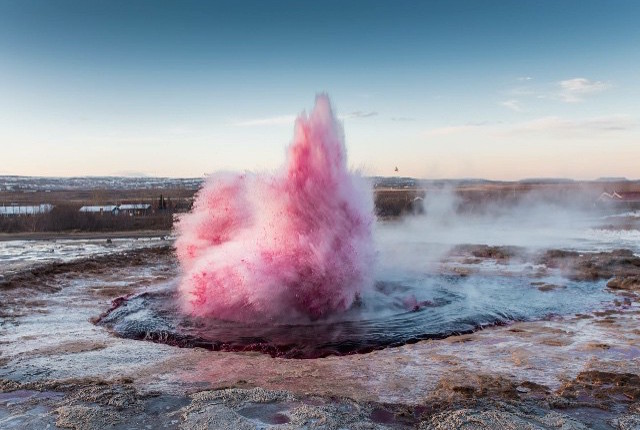
crimes-art-marco-evaristtiA Copenhagen-based Chilean artist was just sentenced to 15 days in jail for creating the above work, which involved pouring a bunch of pink food dye into the Strokkur Geysir. On one hand, it’s kind of a dick move (and his “defense” makes him sound like a pretentious jerk—totally unheard of for artists, I know). On the other hand, damn. I kinda dig it.

Empathy Cards: For when #fuckcancer isn’t enough.

empathy cardsThis series of cards by Emily McDowell are just brilliant. Since Garrett got sick (CliffNotes version: my boyfriend has lymphoma and was diagnosed just a month or so ago) I’ve been hearing a lot of strange, infuriating things from well-meaning family and friends. Like “everything happens for a reason.” Or “you’ll come through this journey so much more grounded.” Or “it could be worse.” cancer cards

Garrett’s currently going through chemo and it sucks. Really bad. The whole thing is just so awful I don’t really want to write about it. I’ve been spending so much time in hospitals that I’ve gotten used to the smell and the strange pastel colors and the forced cheeriness. It’s awful.

Anyway, the point is this: These cards are freaking awesome. McDowell is a cancer survivor and she knows how ridiculously hard it all is. You can buy her cards here and you can read her touching and honest story here.