I love Angela Deane’s joyful little ghosts.

ghost_joy_angela_deaneghost_joyGhost_Images_Angela_Deane_03My favorite images from Angela Deane‘s excellent series of ghost photographs (in which she takes vintage pictures and paints little white ghosts over all the people) have one thing in common: they all feature water. Perhaps that’s because swimming, for me, is such a joyful act, and these ghosts seem like oddly happy creatures, despite their featureless, faceless nature. Or maybe it’s because water has a strange, reality-bending property (as well as light-bending abilities) and ghosts inhabit that in-between place of real and not-real. Or maybe it’s because I’m craving summer and dying to shed some layers. Or maybe because it feels so irreverent, combining that spooky blankness with such standard images of All-American Summer Fun.

Or maybe who cares! Deane is a clever, funny artist with a great visual style and a wonderful collection of old photos to draw from (and upon!). See more here. 

Poem for today: “Toward you, I thistle and I climb.”

Screen Shot 2016-01-10 at 3.35.37 PM

Reader unmov’d and Reader unshaken, Reader unseduc’d
and unterrified, through the long-loud and the sweet-still
I creep toward you. Toward you, I thistle and I climb.
I crawl, Reader, servile and cervine, through this blank
season, counting—I sleep and I sleep. I sleep,
Reader, toward you, loud as a cloud and deaf, Reader, deaf
as a leaf. Reader: Why don’t you turn
pale? and, Why don’t you tremble? Jaded, staid
Reader, You—who can read this and not even
flinch.

Excerpt from the beautiful, strange poem “sweet reader, flanneled and tulled” by Olena Kalytiak Davis, found via an article on The Poetry Foundation, which suggests an alternative reading: swap “reader” for “lover” for a new perspective on this strange and seductive poem. And a word of advice: you really should read it aloud. It rolls around in your mouth, sometimes fluid and smooth, sometimes twisty and thorny, words running together and hard to get out. Reading poetry is the perfect activity for a rainy Sunday. Take a moment and savor it.

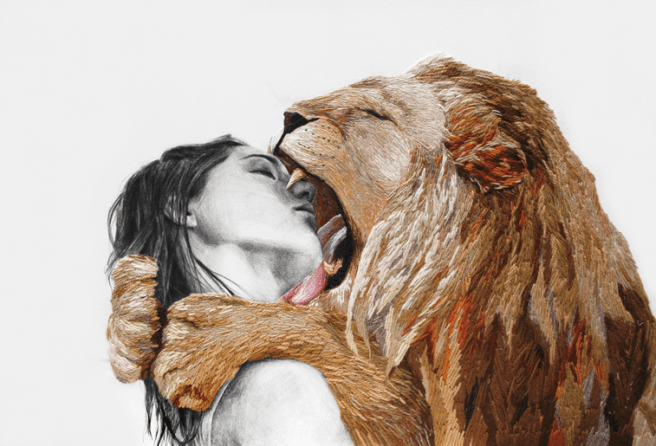
Image: Embroidery and drawing by Spanish artist Ana Teresa Barboza. I’ve featured her art on my blog before, but I couldn’t find a better image for this poem—the lion-girl just fits the scary seduction theme so well, I think.

Why I read, why I write: Erica Jong edition.

Aleksandra Waliszewska

Beware of books. They are more than innocent assemblages of paper and ink and string and glue. If they are any good, they have the spirit of the author within. Authors are rogues and ruffians and easy lays. They are gluttons for sweets and savories. They devour life and always want more. They have sap, spirit, sex. Books are panderers. The Jews are not wrong to worship books. A real book has pheromones and sprouts grass through its cover.  – Erica Jong

A very close friend recently told me that she finds my writing to be extremely tactile and sensory. That made my day. I have been told that my writing can be very physical before, that it oozes a little. Once, a copyeditor pointed out that my description of white water rafting sounded a bit too much like a description of rough sex. While I was mildly embarrassed (and pretty amused), I have to admit I was also a little proud. It wasn’t the effect I was going for (I was aiming for adrenaline and I guess I overshot!) but I think the slightly-sexual-ness comes from an interesting place. When I read for pleasure, I am drawn to writers who make everything feel sexy and alive and real. I admire prose that makes my stomach churn and my spine tingle.

Here’s something I’ve come to realize about myself: I want to viscerally connect with everything. People, places, animals, buildings. You name it, and I probably want to touch/taste/feel/smell it. I want this impulse to translate into something more than just a desire for experience, and sometimes I think it does (other times I think I’m just a glutton for novelty). I think, with a little more rigor, I can shape that into something worth reading. I want to pull out my guts and assemble them on paper, blood staining white to red, hands messy with the effort. And to be totally honest, I’m just practicing right now, on this blog. This is where I play around with words. It’s where I hone my skills and sharpen my knives. (So thank you for reading, because every page view makes my effort feel WORTH IT in a very real way.)

Today, I feel inspired by the work of Erica Jong, who makes me want to be a better writer and person. I’m inspired by my friend, Sophie, who gave me that lovely compliment mentioned above. (If I write from the gut, Sophie writes from the heart, and her heart is a compassionate, fierce, and beautiful place.) Finally, I’m inspired by Aleksandra Waliszewska. She makes art that is outlandish, pagan, brutal, and just a little bit pretty. For me, she strikes all the right notes in perfect order. Check out her stuff, and see if you agree.

A small and lovely thing for which I am grateful.

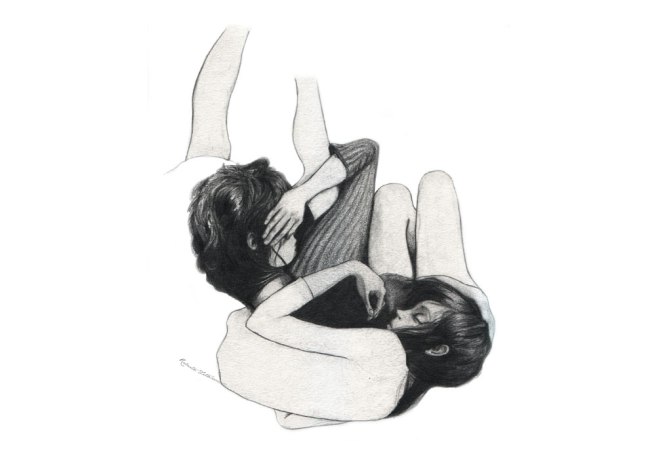
Roberta_ZetaI love the way people move around a sleeper. The exaggeratedly slow motions, the subtle attempts to be quiet, the way they step lightly. Have you ever seen a child tiptoe around their dreaming parent? It is the sweetest thing—they invariably seem to make more noise as a result of their awkward little steps, overcareful and unnatural, burdened with an excess of intent.

I confess: I sometimes pretend to have fallen asleep because I love to listen to how others move around me. When I stay at my mom’s apartment, I feign rest for longer than I’ve been awake. I lie there, listening to her quietly put on the kettle for her morning tea. She shuts the refrigerator with elaborate slowness as I stay still, silent, with closed eyes and slowed breath. Of course, I most often experience this sensation around Garrett (my roommate and love). Sometimes, when I am close to sleep or very relaxed, I will feel him begin to pull his arm from out from under me, gradually inching it from under my neck. I could just tell him I’m still awake, and if he wants to go play video games, I don’t mind one bit. But instead I let him extract his arms from my tangles of hair and move out of the room with calculated lightness. The door shuts without a creak, no puff of air to mark the insignificant transition from one state to the next.

I’m not sorry for this little white lie, because it is such a happy thing, to be taken care of as you sleep.

Image: Picture by the very talented illustrator Roberta Zeta. See more here.

“A wandering mind unsticks us in time.”

Screen Shot 2015-12-27 at 4.31.32 PMNeed something to read in your post-holiday downtime? Here are a few interesting things from around the web, including the story of a very fancy French dominatrix, a theory about the real Jack the Ripper, and an article on why your brain needs to chill. Here we go!

A smart, obsessive screenwriter from England thinks he has figured out who Jack the Ripper really was, and he has a convincing theory as to why police never caught him. He suggests there was a massive cover-up born out of the cop’s connections to freemasonry (and the politicians and royals, too). The real Ripper was a philandering songwriter named Maybrick (in my head, I picture him like an old timey Mark Ronson):

In 1992 a diary surfaced in Liverpool, ostensibly written by a man named James Maybrick, in which he confessed to being the Ripper. Maybrick – who also happens to have been a Freemason – was a cotton trader and serial adulterer who died in 1889 as a result of poisoning. In one of the most controversial trials of the era, Maybrick’s wife Florence was convicted of the murder.

The diary was dismissed as a hoax. But reading it, something struck Robinson as a little odd. ‘It was written in three acts. Nobody writes a diary in three acts, because you don’t know what the third act will be. But the middle act, talking about the homicides, was so potent, so powerful, it got me thinking it could have been written by the murderer.’ But not by James Maybrick. Jack the Ripper, Robinson believes, was Maybrick’s brother Michael.

Michael Maybrick was a hugely popular singer and composer in the Victorian era, who is virtually forgotten today – for reasons that Robinson believes are no accident. He was particularly well known for his sentimental seafaring songs, written under the pen name Stephen Adams, among them Nancy Lee, the sheet music of which sold more than 100,000 copies in two years, and – ironically – They All Love Jack, which was written in 1887, the year before the Ripper killings began. His composition The Holy City sold more than one million copies, making it the best-selling song of the 19th century.

This Vanity Fair feature about a French author/dominatrix is straight-up bananas. It’s kind of over-written in that fancy, Voguey kind of way, but trust me, it’s still a reallllly good read. Here’s a taste:

Catherine embodied his lifelong obsession with young girls, resembling a little girl in her height, size, and manner. “Alain always said, ‘She’s my wife and my children,’ ” says Catherine. Well into her 30s she was regularly mistaken for Alain’s daughter. (Vladimir Nabokov met Catherine when the Stanley Kubrick film of his best-selling book was being cast and abruptly announced, “I want her to be Lolita!” He was sorry to learn that she didn’t speak English and so couldn’t play the role.)

Here’s an interesting detail about her book, which was published sous la table (a completely unnecessary bit of French is par for the course with this kind of rich-person profile. Note to self: Never do that!):

Susan Sontag named L’Image, alongside Story of O, as an example of pornographic books that she regarded as “belonging to literature.” And the book uncannily foretold Catherine’s own future erotic switch—17 years later—from submissive to dominant… L’Image was banned upon publication. The police arrived at the office of the publisher, Jérôme Lindon, demanding to know who was this “Jean de Berg”? “I have no idea,” lied Lindon, and, under their orders, he handed over copies of the book, which were burned. However, he continued publishing the book sous la table.

While we’re on the topic of sex, here’s a weird question: How does one design a cover for the book Lolita? Obviously, it is a difficult task, since designers need to chose imagery that nods at the subject matter but doesn’t glamorize it or sexualize the character. Many have tried. (And many have failed—too often the book looks like it’s about a consensual love affair between a precocious, sexy teenager and an older man, which very, very much misses the point.) Here’s an entire website devoted to Lolita covers, and here’s a great New Yorker article on the topic.
dee-nickerson-freedom-2015-30x40cmFinally, let’s all read this Scientific American story on why your brain needs more downtime and then immediately after, we’ll all close down our computers and go for a walk. Logically, I know I need to take breaks in between working and playing, but it can be really hard to make time for nothing. I’m great at doing things but I’m less adapt at just chilling, solo, without turning on some sort of stimulating device (TV, computer, podcasts, etc). But this article makes a great argument for taking out your earbuds, closing that book, and just… thinking. Without distraction. Here’s a good bit:

In making an argument for the necessity of mental downtime, we can now add an overwhelming amount of empirical evidence to intuition and anecdote. Why giving our brains a break now and then is so important has become increasingly clear in a diverse collection of new studies investigating: the habits of office workers and the daily routines of extraordinary musicians and athletes; the benefits of vacation, meditation and time spent in parks, gardens and other peaceful outdoor spaces; and how napping, unwinding while awake and perhaps the mere act of blinking can sharpen the mind. What research to date also clarifies, however, is that even when we are relaxing or daydreaming, the brain does not really slow down or stop working. Rather—just as a dazzling array of molecular, genetic and physiological processes occur primarily or even exclusively when we sleep at night—many important mental processes seem to require what we call downtime and other forms of rest during the day. Downtime replenishes the brain’s stores of attention and motivation, encourages productivity and creativity, and is essential to both achieve our highest levels of performance and simply form stable memories in everyday life. A wandering mind unsticks us in time so that we can learn from the past and plan for the future. Moments of respite may even be necessary to keep one’s moral compass in working order and maintain a sense of self.

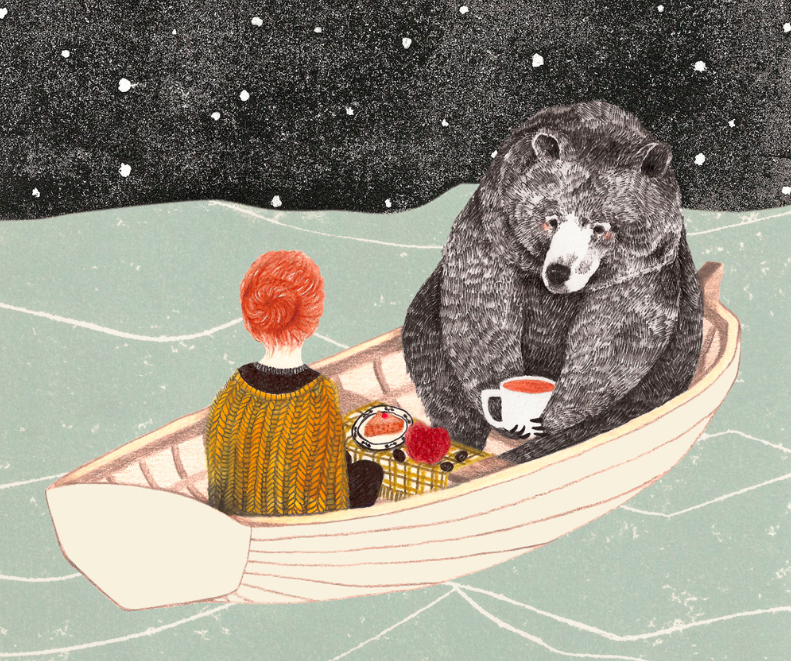
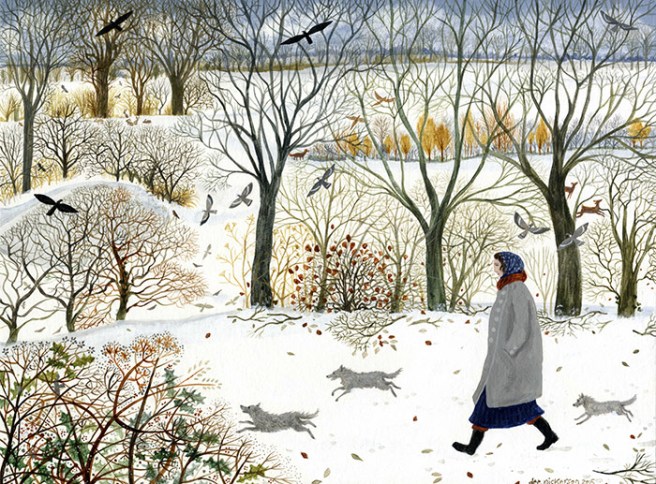
Top image via Pinterest, artist’s page here. Second image by artist Dee Nickerson. See more of her work here

On polar bears and Barry Lopez.

Screen Shot 2015-05-11 at 8.50.19 PMI dream about bears.

I am not sure when bears entered my subconscious in such a strange and vivid way, but they did, and I think they may be here to stay. I dream about ferocious grizzlies and playful fat black bears. I dream about big white bears with paws the size of dinner plates and hollow hair that gleams creamy-yellow in the northern sun. In my dreams, I see cubs climbing trees and sliding over the ice. I sometimes think I can smell them in my sleep; I’ve been told they smell of pinesap and animal musk. Sweet, sticky, fresh, brutal.

Sometimes, out of the corner of my eye, I think I see a bear. I never see these phantom bears in the woods or in any landscape when I might meet an actual bear. Once, when I was very tired and working late at Maine magazine, I thought I saw a bear descending the stairs on all fours. Of course, it was just my co-worker, bending over to pick up something he had dropped. I shook my head clear of fuzz and fur, and went back to my computer screen.

I don’t know where this fixation comes from. I never liked bears, not particularly. I always felt kinship with hares and foxes, smaller animals that leap and scurry, not big lumbering things. I was never afraid of bears, either. Not like I’m afraid of heights (that terror is illogical and visceral, something that breaks my composure entirely, turning me into a quivering puddle of metallic fear and foul-smelling sweat).

I saw a video today of a polar bear cub dreaming. I wonder if it dreams of people. I hope not. I hope it dreams of calving glaciers and frigid ice floes, of the epic sounds of its northern homescape. I hope it dreams in a palette of blue and turquoise, deep rich indigo and startling mint green—the colors of frozen water and star-lit midnight.

I am reading a most excellent book right now: Arctic Dreams by Barry Lopez. Never have I found an author whose career I desire as much as I want his. He makes nonfiction feel as pleasurable as fiction (and that is NOT an easy task). Someday, when I’m old and grey and going over my body of work, I want it to feel like his—varied, complex, focused on nature and the natural world, brave, smart, poetic. Here’s just a tiny sample of the wisdom and beauty that flows throughout Arctic Dreams:

How is one to live a moral and compassionate existence when one is fully aware of the blood, the horror inherent in life, when one finds darkness not only in one’s culture but within oneself? If there is a stage at which an individual life becomes truly adult, it must be when one grasps the irony in its unfolding and accepts responsibility for a life lived in the midst of such paradox. One must live in the middle of contradiction, because if all contradiction were eliminated at once life would collapse. There are simply no answers to some of the great pressing questions. You continue to live them out, making your life a worthy expression of leaning into the light.

Dreaming of bears and leaning into the light—one is my reality, the other, my goal. Not a bad place to be, for now.

Image: Sculpture by artist Ellen Jewett who makes “natural history surrealist sculpture.” See more here. 

Painted ladies by Jessica Harrison.

Screen Shot 2015-11-27 at 11.20.07 AM
I love tattoos. I know they’re not for everyone, but I like ink on skin. I like the strange burning tingle of the needle. I like the ritualistic aspect of the tattoo parlor. I like the way my skin responds, raised at first, textured as it heals, eventually relaxing into a smooth surface, newly pattered, altered.

Part of the reason I love tattoos is because they afford a certain amount of control. Our bodies are so frequently outside our control. They get sick. They betray us when we’re anxious or scared, running on adrenaline, heart jumping, head spinning. Have you ever fainted? There’s nothing quite like the sense of slow descent, the edges of vision turning black, the unwilling fall into unconsciousness.

But I can control my tattoos. They let me tell the story I want to tell. They also feel like an easy rebellion, a way of saying that my femininity is my own. Traditionally, women weren’t tattooed. Women were delicate flowers. Tattoos were for hard men, criminals, sailors. Now, I can be all three. A woman, a rogue, a wanderer. I can wear it on my skin and broadcast my not-a-freaking-lady status to the world.

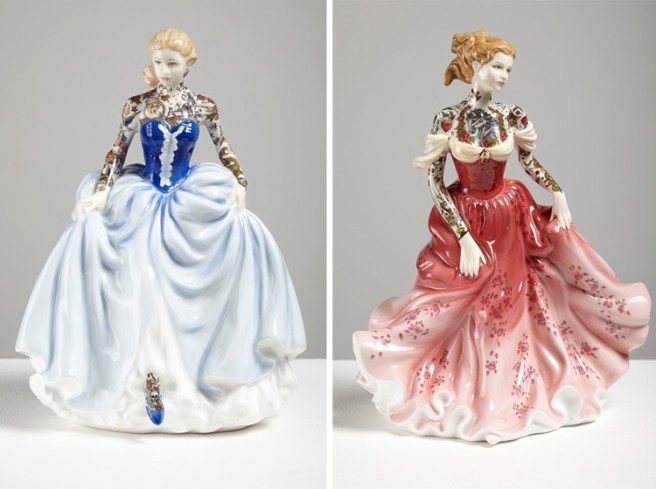
1_tattoo_painted_porcelain_sculpture_jessica_harrison8copyI’ve been meaning to blog about Jessica Harrison‘s wild ceramics for a long time, but I couldn’t think of what to say about them, aside from I LOVE IT. She takes a familiar object—those little ceramic figurines—and turns them dark, modern. Some are gruesome, with melted faces and zombie-hands. Others are just tattooed. I love all her work, but I admit my favorite are the painted ladies. Their subversion is more subtle than the Kahlo-like dancer, who holds her bloody heart in her cold, porcelain hands. They’re beautiful, with their big skirts and delicate ink. They’re lovely ladies and bold scoundrels, and I think they’re just great. 

Build-a-genius, go outside.

girla nd her bear

In her famous essay the Ecology of Imagination in Childhood, Edith Cobb proposed that contact with nature stimulates creativity. Reviewing the biographies of 300 “geniuses”, she exposed a common theme: intense experiences of the natural world in the middle age of childhood (between five and 12). Animals and plants, she contended, are among “the figures of speech in the rhetoric of play … which the genius in particular of later life seems to recall”.

Studies in several nations show that children’s games are more creative in green places than in concrete playgrounds. Natural spaces encourage fantasy and roleplay, reasoning and observation. The social standing of children there depends less on physical dominance, more on inventiveness and language skills. Perhaps forcing children to study so much, rather than running wild in the woods and fields, is counter-productive.

From an essay on the “second environmental crisis” in The Guardian by George Monbiot. He argues that kids these days don’t spend nearly enough time outdoors, which has caused many people to lose their desire to fight for environmental rights. It makes perfect sense—the most eco-minded folks are usually people who really like nature and spend a significant amount of time in it.

It reminds me of a piece I read earlier this year about wild words being removed from children’s dictionaries. The publishers at Oxford University Press decided that some words were more relevant to modern kid’s lives than others. What’s out? Bluebell, newt, and willow. What made the cut? Broadband, block graph, and celebrity. Ouch, right? My personal hero, Margaret Atwood, protested the change, and when someone who specializes in spookily prescient dystopian fiction warns of a dangerous societal shift, well damn, I sit up and listen.

Clouds like poems and poems like clouds.

Mammatus_clouds_in_the_Nepal_Himalayas

Unburdened by memory of any kind,
they float easily over the facts.

What on earth could they bear witness to?
They scatter whenever something happens.

Compared to clouds,
life rests on solid ground,
practically permanent, almost eternal.

Next to clouds
even a stone seems like a brother,
someone you can trust,
while they’re just distant, flighty cousins.

From “Clouds” by Winslawa Szymborska, a Nobel Prize winning Polish poet who writes beautifully about the natural world and the human heart. Read the entire poem in English or in Polish here.

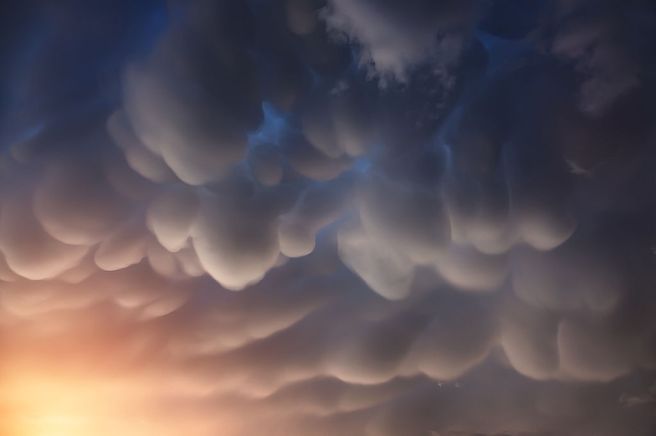
The clouds shown in the image above are mammatus clouds, also known as mammatocumulus. The name comes from the Latin word mamma meaning “mother” or “breast.” Beautiful breast clouds, swinging their udders in the sky.

Also, did you know that the World Meteorological Organization has a section called “Weather reports from the future?” I’m almost afraid to click on it, because I want it so badly to be something oddly magical or slightly silly. I assume it’s about climate change—an important topic! obviously!—but I wish it were stories from a future meteorologist, sending his weather reports back in time to us, boring dispatches about the sky from an unimaginable life form.

How is your heart doing?

Screen Shot 2015-06-29 at 12.31.23 AMIt’s a familiar script. “How are you doing?” asks one friend. “I’m so busy,” says the other. Or, if you’re me, “I’m underwater with work. I’m so busy I’m practically drowning.” Underwater. That’s how I describe my life far too frequently. If I don’t utter a noncommittal and unconvincing and ungrammatical “I’m good,” I almost always say I’m busy. I tell everyone what I’m doing, not how I’m doing. I talk about actions and places to be, things to accomplish, plans and goals—all the things that tug on my subconscious and give me anxiety dreams. The things that pull on my insides. The things that tax me. (What a great word, right? The things that tax us. That take away pieces over and over and over.)

But it doesn’t have to be like this, explains Omid Safi:

In many Muslim cultures, when you want to ask them how they’re doing, you ask: in Arabic, Kayf haal-ik? or, in Persian, Haal-e shomaa chetoreh? How is your haal?

What is this haal that you inquire about? It is the transient state of one’s heart. In reality, we ask, “How is your heart doing at this very moment, at this breath?” When I ask, “How are you?” that is really what I want to know.

I am not asking how many items are on your to-do list, nor asking how many items are in your inbox. I want to know how your heart is doing, at this very moment. Tell me. Tell me your heart is joyous, tell me your heart is aching, tell me your heart is sad, tell me your heart craves a human touch. Examine your own heart, explore your soul, and then tell me something about your heart and your soul.

Last night,  a friend asked me how I was doing. I didn’t have words at the moment. Instead, I started crying in the middle of a bar. Crying in public is a strange thing—to be so intimately on display in such an uncomfortable, unscripted, undesirable way. It’s a little grotesque, and people never know where to look. And yet I do it all the time. Partially because I’m just overflowing a little bit all the time, but also because I’ve stopped caring about whether my current emotions are too much. (When I did care about this, the answer was always. They are always too much.)

But also, I’ve learned that crying in front of others can become joyful far more quickly than crying alone. Yes, I do feel ridiculous when my eyes are leaking saltwater and my nose is threatening to join in. But then I saw her face become sweet and sad and concerned. And my heart began to feel less scorched, less fragmented. Sometimes, the recognition of others, their willingness to ask about the shape of your heart, sometimes that can give back the little pieces that are taxed away by the everyday. It gives you back the bits of yourself that you didn’t realize you had lost.

It’s attentiveness and recognition. To be seen. What a gift.

How is your heart doing today, friend?

P.S. The art above is available for purchase here, along with many other very beautiful drawings and pieces. Go check it out.