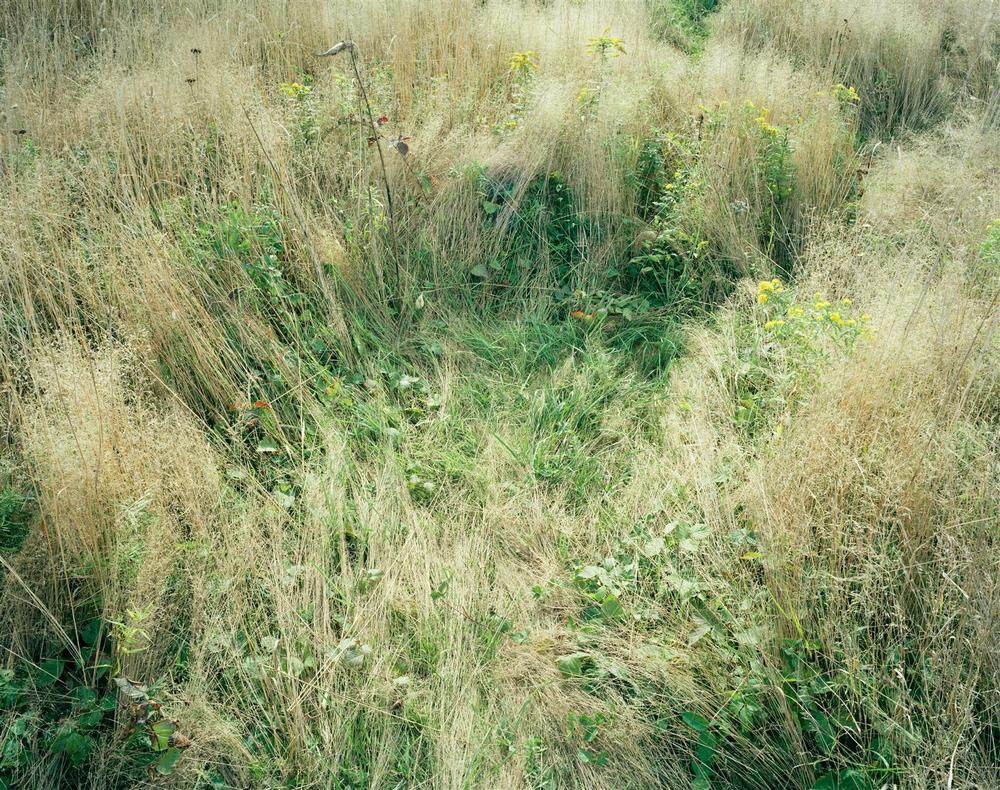
Sweet science: deer beds.

Katherine_Wolkoff_DeerbedHere is something I learned today: Deer beds are beautiful.

Here’s another thing: Deer travel and live in herds. They’re social animals—to an extent. While the bucks are off… doing whatever it is bucks do, the lady-deers come together. The female deers and their little dappled fawns bed down together in large groups, while the bucks only hang out in groups of three to five (they are constantly fighting for dominance, which weakens the herd dynamic, kind of like when you go out with a few guys and they start playing darts and the night quickly dissolves into puffed chests and hurt feelings).

Hunters often track deer based on the imprints they leave when they lie down to rest. They create oval-shaped indents on the ground, crumpled swirls of grass. In the winter, their body heat melts the snow beneath, so if you see a few round melty spots, that’s probably a deer bed. Katherine_Wolkoff_deerbed_2

Photographer Katherine Wolkoff has created a series called “Deer Beds,” and I’m absolutely in love. To capture these images, she followed deer around Block Island, stopping where they did and training her camera on their nocturnal nests. The photographs (above) are strangely intimate and human. Touching and wild. Sweet and subtle. Imagine stumbling on a one of these deer beds in the wild grass. Lie down, it’s still warm from their gentle heat. Smell the plants, prickly and pungent, green and growing. Go to sleep. Dream of the herd, prancing away without you. Oh, deer.
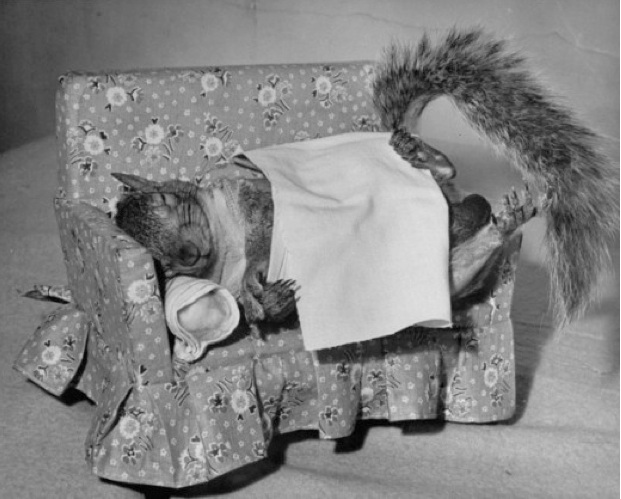
A funny little squirrel.

squirrel_tommyThis silly little guy is Tommy Tucker. In the 1940’s, he became mildly famous when LIFE magazine photographer Nina Leen decided to turn her lens on Tommy. His owner made him some sharp new outfits (all dresses, because, I have to assume, squirrels hate pants as much as I do) and a rodent star was born.

Hyperallergic has the full, creepy-cute story.

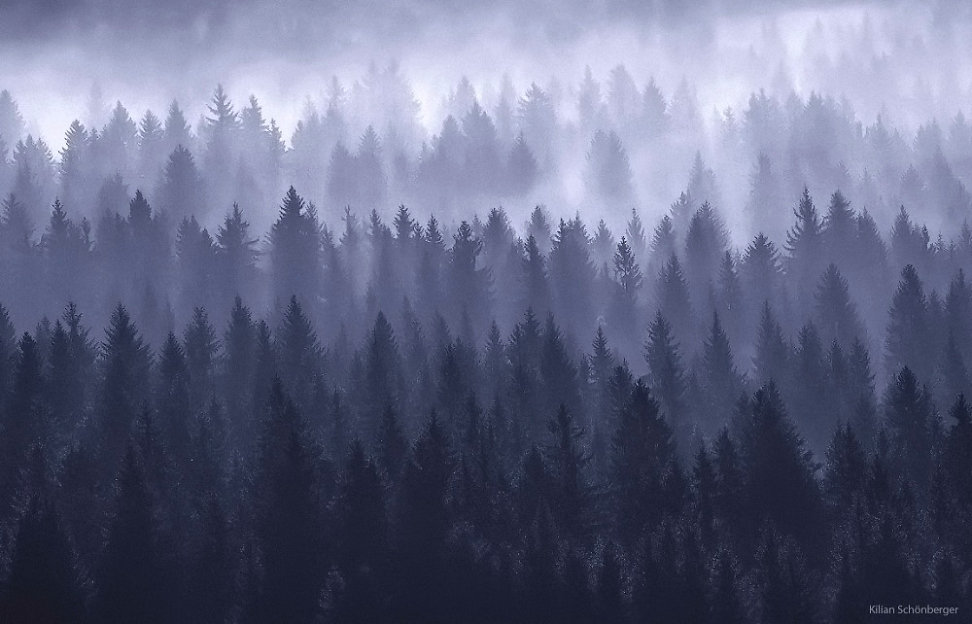
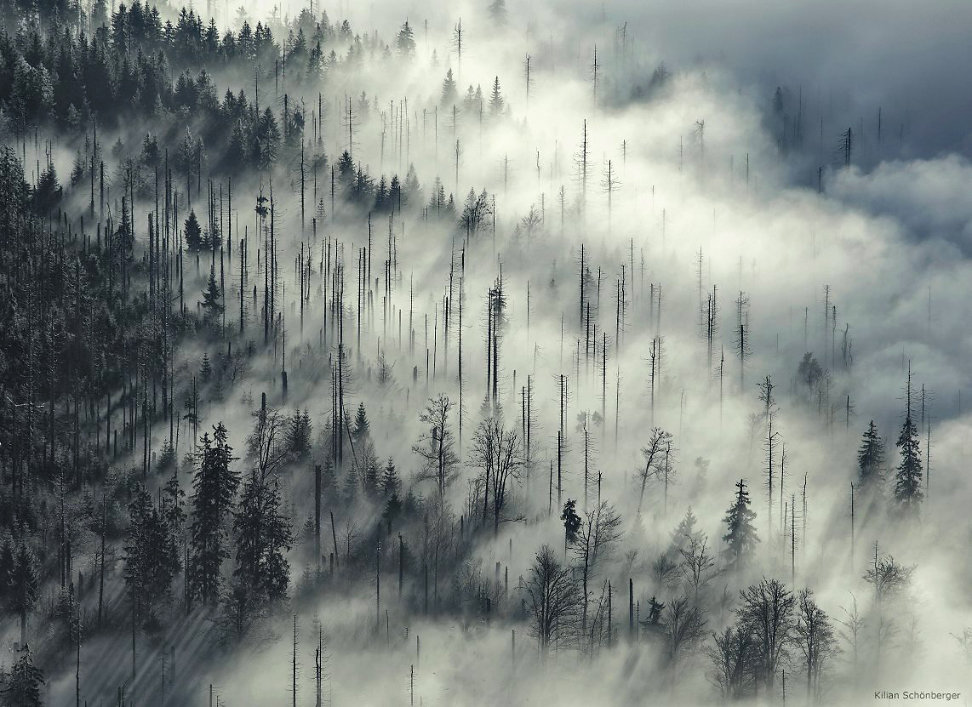
Sunday daydreaming: Kilian Schöenberger’s misty woods & “Indie Alaska.”

Image by Kilian Schoenberger, via his website

It’s snowing again. Es schneit. Il neige. Det snöar. I don’t believe it will ever stop snowing. It is going to simply pile up and up and up until we can walk out our bedroom window onto a shifting landscape of cold pale light. I’m drowning in snow. My eyes are starving for color, but instead it’s wind-whipped and white everywhere I look. My eyelids froze shut when I was walking outside yesterday, eyelashes glued together by snowflakes and tears. It sounds poetic, but it felt strange and disorienting.

There’s no color in the Maine landscape right now, which means I must find it elsewhere, and right now, “elsewhere” is a screen. But Kilian Schöenberger’s photographs are gorgeous and make me view the winter landscape with a little more forgiveness. It can be beautiful, despite my cabin fever. kilian schoenberger trees

Continue reading

Just because it’s pretty: Amanda Charchain’s too-cool nudes.

amandacharchainAmanda Charchain has some amazing photographs of nudes in the woods, girls frolicking in fields, and desolate, lonely landscapes. It’s all great, but this picture is just so perfect—a piece of brightness and color for a rough, cold Thursday.

Girls.

nz-10I’ve been thinking a lot lately about the friendships that form between girls. As a kid, I always had just one best friend. I tended to have these incredibly close, very intense relationships with just a single person. I guess you could say my serial monogamy began back in grade school, because as an adult, I do the same thing with men.

I think I’ve always been drawn to the intimacy that can arise between a pair of two—especially between two girls. For years, the most important relationship in my life was with a friend named Sara. We spent every free moment together; we held hands, we called each other every night; we talked alike and acted alike. We were eventually voted “Dynamic Duo” in our high school yearbook. Even now, when fiances and boyfriends have become our Significant Others, we remain close. But the giddiness, the head-tingling pleasure of whispering secrets, the sweet feeling of acceptance—all that is something I will always link to childhood. To late night sleepovers and days spent passing notes, written in glitter pen, folded with intricate origami, and written in the secret language that passes between middle school girls.

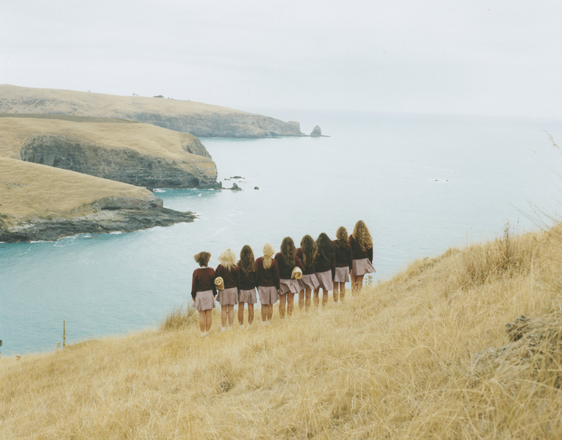
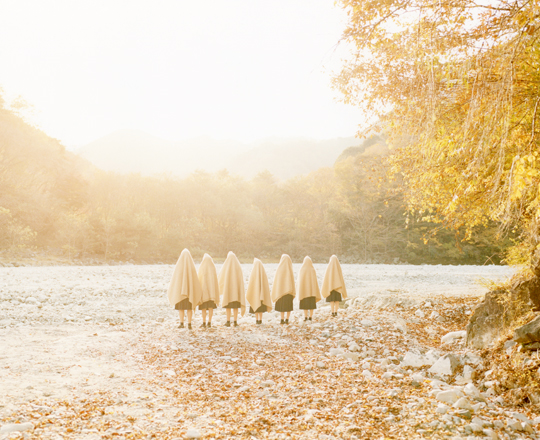
While her photographs don’t depict groups of two, Osamu Yokonami’s series of schoolgirl portraits remind me of that strange, almost mystical feeling of becoming so very, very close with another person. There is nothing sexual about it, but in some ways, that makes it even more intense; it’s wanting to be someone, to inhabit the same space, to have an identity that is somehow more than yourself, yet lighter, more diaphanous, full of sweetness and light and air.
as9
Dressed in uniform, these girls are seen from a distance. At this range, they all look the same. They could have come out of the same wooden doll, little matryoshkas walking one by one across a snowy field. They could be dolls or demons. They meld together, these girls.
ase03
The entire series is gorgeous, as is all Yokonami’s work. There is a dreamy quality to it that reminds me of old photographs, shot with clunky cameras and developed in dark rooms. See what I mean, here.

Fong Qi Wei blows up blossoms.

Rose Exploded 01, SingaporeIf you ask my boyfriend, who is a biologist by trade and botanist by passion, he will tell you all about the sex lives of plants. Pistols and stamens and pollen—oh, my! It’s some seriously dirty stuff. I think photographer Fong Qi Wei gets that. His flowers are exploding with joy, bursting with happiness and color and light. His photographs are a psychedelic exercise in neatness. Paradoxical? Perhaps, but I don’t care.
Sunflower Exploded 01, SingaporeSee more here.
{via Laughing Squid}

A few thoughts on death, photography, and Ghost Busters

med_fuss_af-0462-jpgA fascination with ghosts can be written off as whimsical. Often, people imagine Casper or Bill Murray fighting ectoplasmic globs, when one mentions the g-word. True believers might find it a bit more sinister, but even then, they tend to speak of odd occurrences with windows, breathy sounds heard in the night, a persistent shadow that falls without light, old objects found with no point of reference. All things that are possibly spooky, but never truly threatening. As someone who writes frequently about ghosts, I tend to hear a lot of ghost stories. But even when the storyteller is uncomfortable, I find it’s more often out of embarrassment than fear.

But a fascination with death? That’s an entirely different kind of beast. Even the word trails off with fear, lingering consonants that dryly hang in the air. Death is threatening. It is real. It is ugly and universal and either entirely unfair or ruthlessly just, depending on who you ask.

Though I don’t like to think about death, I tend to do it a lot anyway. This helps explain one of my weirder possessions: a book of images from The Burns Archive. The Burns Archive, as you’ll see if you click that link, is a collection of photography that focuses primarily on the grotesque. There are images of soldiers and their gun wounds, portraits of the mentally ill, and lots and lots of postmortem photography.

Why would anyone take a picture of a dead person? Well, this used to be the thing to do when your relative died. It was a curious practice, and often involved propping the deceased up in a chair, pushing their eyelids open, and doing everything possible to make them appear alive. It’s the strangest masquerade; the dead posing as the living in a medium that has been described as a metaphor for death itself. Though I’ve never found the pictures particularly creepy, this idea freaks me the heck out.

And if I’ve just creeped you out, maybe this will bring you some peace: the New York Times recently ran a piece on their Wellness blog about German photographer Walter Schels, who captures his subjects in the days before death, and then again soon after. Instead of being sinister, manipulated and a little bit weird, these pictures are oddly peaceful.

“People are almost always pretending something, but these people had lost that need,” he said in an interview. “I felt it enabled me as a photographer to get as close as it’s possible to get to the core of a person; when you’re facing the end, everything that’s not real is stripped away. You’re the most real you’ll ever be, more real than you’ve ever been before.”

About the image: I didn’t want to clutter up my blog with pictures of dead people, so instead I simply linked to them, and used this gorgeous photograph by Adam Fuss, an extremely talented artist, to illustrate the point. It’s from a series call “My Ghost,” so I thought it was rather fitting.

Late to the party: Nick Knight’s “Flora”

Nick-Knight-FLORA-1-Fashion photographer Nick Knight has been making people gasp for years but I just got to know his work today, thanks to his book Flora. While his pictures of wilting waifs are gorgeous, I’m more drawn to his dripping flowers. They’re drenched with color, saturated with pinks and reds and purples and other colors that remind me of broken veins and beautified bruises. Darkly pretty, except they strike you as pretty first… the eerie feeling creeps in after looking at it a little too long.

It’s like his lovely, lovely photos of women sleeping. At first, they are sweet pictures, images of the body at rest. But then, when you imagine the position of the photographer, the place they must have stood, the voyeurism implicit in such a shot—then they become sinister. Fully realized in their power.

Weird, pretty, creepy, lovely. I like it.

Where the wild things are.

312033_415917278455577_1915020339_nI find it endlessly fascinating how people around the globe have created folklore and mythology that falls along the same basic narrative structures. People as beasts, beasts as people. Spirits that need to be appeased, and sacrifices that must be made. The dead who walk again, and the living who wander into the twilight land between. These stories are told again and again, from language to language and mouth to mouth. It’s beautiful, if you think about it. We’re all beasts, inside. Wild men, in the words of photographer Charles Freger.

02-portugal-lazarim-character-caretos-670Freger captures the wild men of Europe in their various costumes and headdresses. With a few simple materials, the human body is transformed into fantastical shapes, shaggy creatures of imagination and deep symbolism.

312090_415917238455581_1283995928_nLooking at his photographs, I find myself feeling an odd envy. I have never enjoyed Halloween and the skimpy outfits it seems to inspire, but I would love to turn myself into a fearsome (yet wooly) creature, a brute straight out of a fairytale.

Alternatively, it would be nice to go around Europe snapping pictures of these colorful rituals. Feed your own envy here.