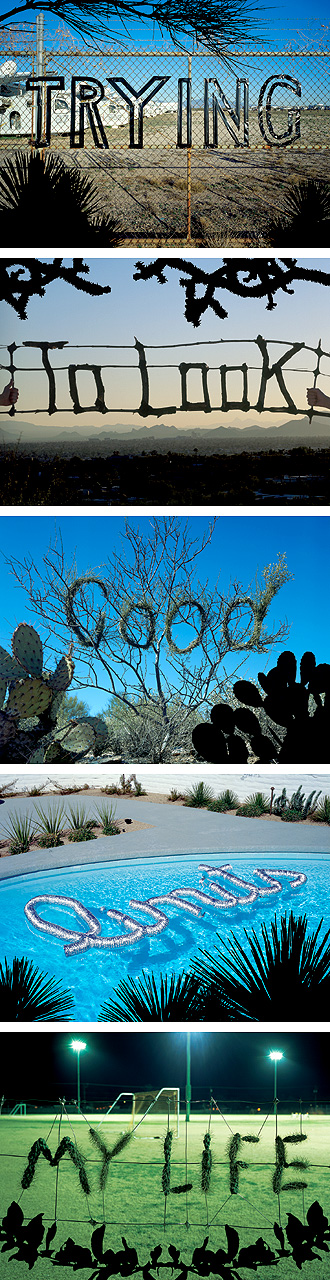
Three Nice Things

Sometimes, I don’t think there is enough art (and writing and culture) devoted to capturing happiness. Stefan Sagmeister’s show at UPenn is great because it’s just that: happy stuff. Using typography and photography to illustrate inspirational sayings, it’s a bit like Pinterest got an art show… but in a good way!

But it’s not just light-weight eye candy. Sagmeister also incorporated some science into the show:

To contextualize the maxims that appear throughout the exhibition, Sagmeister has gathered the social data of Harvard psychologists Daniel Gilbert and Steven Pinker, psychologist Jonathan Haidt, anthropologist Donald Symons, and several prominent historians. A 12-minute segment of the Happy Film, a feature length exploration of whether it is possible to train the mind the way we train the body, will also be on view.

Cool. Especially since Daniel Gilbert is so great—he gave one of my very favorite TED Talks. It’s about how to be happy (of course) and the importance of synthetic happiness. Turns out, how we conceptualize happiness can really limit our enjoyment of things. Not everything has to be external for it to be real. Obviously, he explains it MUCH better than I am, so go watch it here.

Finally, though it’s a little unrelated, Sagmeister’s art reminded me of a great video that I think I found via the Jezebel commenting section. But don’t let that stop you from watching it! It’s a really great video on what being “pretty” means, and why you should never, ever want to be “just pretty.” Trust me on this one, it’s pretty cool.


Image: “Trying to look good limits my life” Art direction: Stefan Sagmeister. Design: Stefan Sagmeister, Matthias Ernstberger. Photography: Matthias Ernstberger. Client: Art Grandeur Nature.

Resting.

It has been a really great weekend, full of beaches and cocktails and gardening and everything else that I like. But now that it’s over, I’m pretty exhausted—in the best possible way.

For no other reason than it’s beautiful, I wanted to share this image from Sir Lonie. He does these fabulous Schiele-esque sketches and they’re all licensed under creative commons. When it comes to images, there’s so much internet thievery that’s done with the best of intentions (we all just want to share something pretty!) but when it comes down to it, it’s still stealing. It’s really nice to know that this drawing—and all of his pieces—are intended for precisely this purpose.

Check out his drawings (and animation). They’re pretty great.

Good Night.

I’ve been meaning to post about Robert Knight’s photos for a long time now because they are ghostly and fantastic and utterly strange. For his series “Sleepless,” the Hamilton College professor/artist took long-exposure photographs of people tossing and turning in their beds. The project was inspired by his own issues with insomnia (which is something I can relate to in a very big, very unfortunate way). The result is a cluster of images that capture the restless movement of a body in a bed while obscuring all identifying features of the subject. I find it creepy, touchingly intimate, and oddly beautiful.

You can read more about “Sleepless,” which also includes videos and installations called “sleep boxes,” at Knight’s website.

{via}

I Love Public Art, Part III.

As previously mentioned, I adore public art. I mean, I kind of just generally love art as a principle of life, but I really like the stuff that makes its way out of the museums and onto the streets, where it can confuse, excite, terrorize or please the populace just by existing.

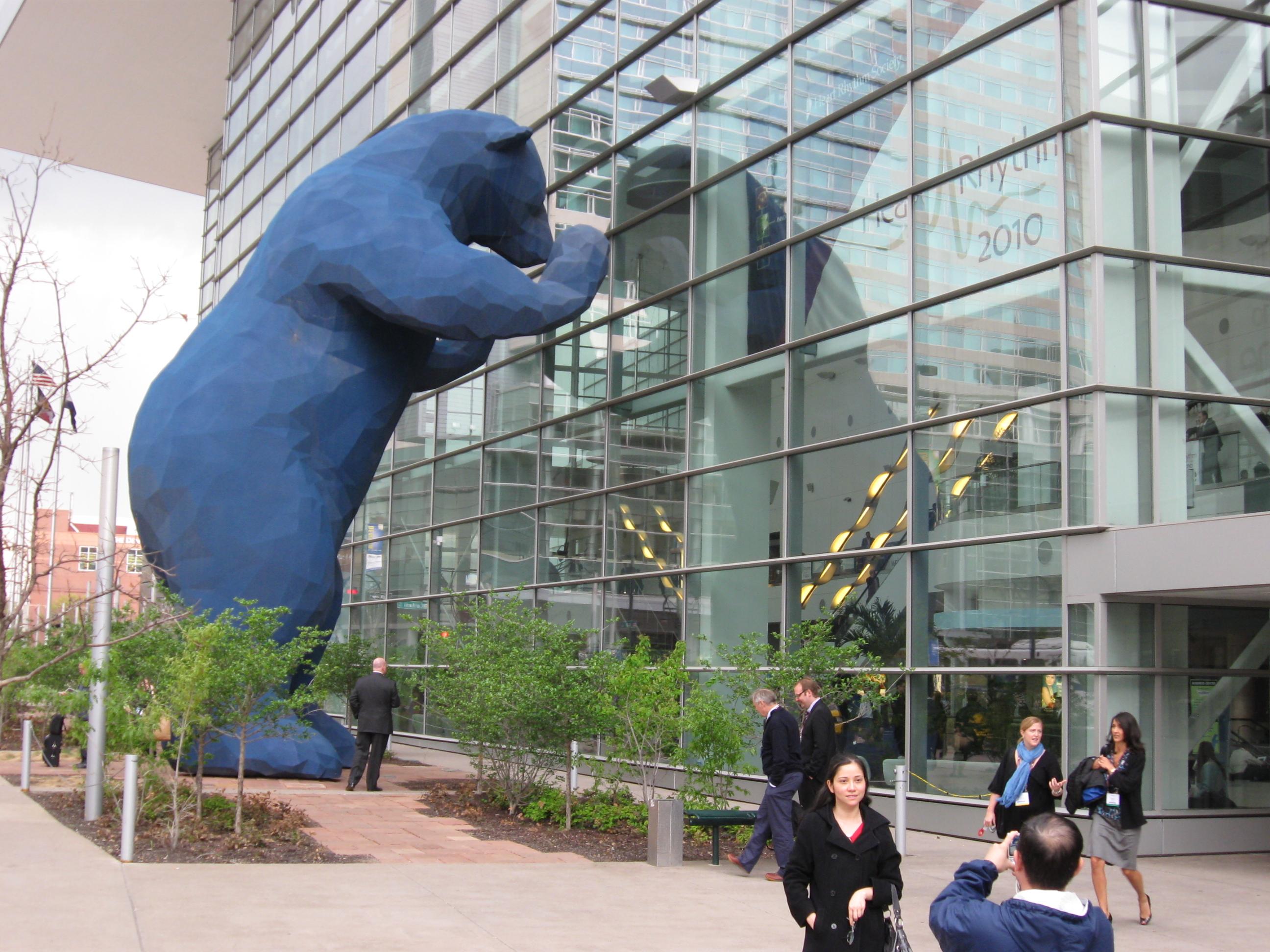
But I realize a lot of people just ignore public art, seeing it as just another part of the cityscape—or worse, they let their eyes glaze over it as they search for the nearest Starbucks or whatever. I know. Why would you do that? It’s so nice! However, sometimes you can’t ignore it, like with Lawrence Argent‘s “I see what you mean.” Continue reading

Such Great Heights.

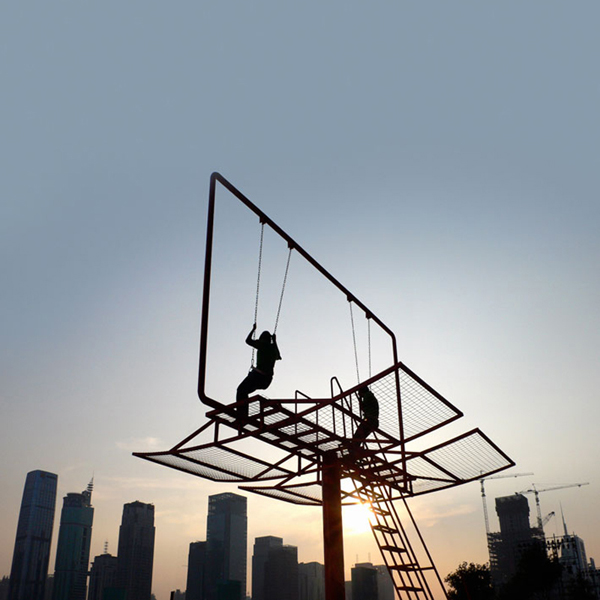
Parisian architect Didier Faustino turned an old, unused billboard into a swing set. Though I get shivers just looking at it (acrophobia is a very real thing), I think it might be worth the nausea to see a city from this perspective. It must feel like flying.

Faustino himself has some pretty cool stuff to say about the piece, which he calls “Double Happiness:”

Double Happiness responds to the society of materialism where individual desires seem to be prevailing over all. This nomad piece of urban furniture allows the reactivation of different public spaces and enables inhabitants to reappropriate fragments of their city. They will both escape and dominate public space through a game of equilibrium and desequilibrium. By playing this “risky” game, and testing their own limits, two persons can experience together a new perception of space and recover an awareness of the physical world.

It sounds a little like the justification they use on “The Bachelor” every time they have one of those weird fear-dates—though I suspect the producers on that show are far more interest in reusing their favorite metaphor: falling off structures as a painfully heavy handed analogy for “falling” in love. Faustino makes this entire process sound vastly more interesting (and a little bit trippy).

Anyway, I like it. Found via.

Childishness.


Grown-up

Was it for this I uttered prayers,
And sobbed and cursed and kicked the stairs,
That now, domestic as a plate,
I should retire at half-past eight?

– Edna St. Vincent Millay


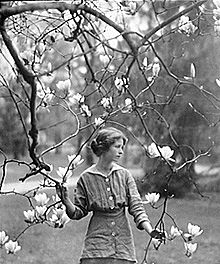
I was once told, by a boy who had been pursuing me for some vague and nebulous purpose, that I resembled the writer Carson McCullers. I was suitably flattered and began to view Carson with the strange nepotism I afford all my suggested look-alikes (apparently, while I have a face people tend to see all the time on the street, there is no television equivalent. This once made me kind of sad, but that was before I realized how little that actually meant about me and my hundreds of common doppelgangers).

And though Carson is certainly a great person to be compared to in any capacity (and despite her infinitely less beautiful name and comparatively plain face), oh how I wish it had been Edna!

Two Nice Things.

Image
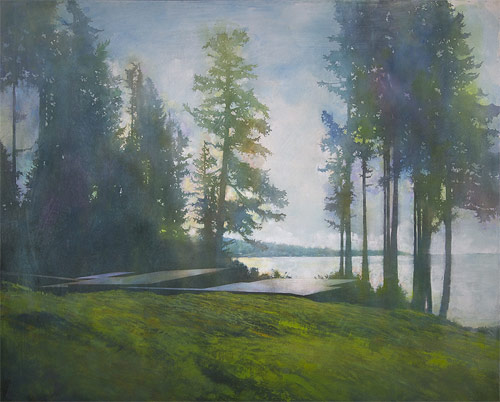
1. Canadian artist Erin Mcsavaney paints beautiful pictures of buildings in nature. Quoting Walter Benjamin, she calls architecture “the most binding part of communal rhythm,” a thing based on rules and parameters and angles and lines. Her paintings, which all seem hazy and water-logged, play with the sharp edges of buildings, the soft lines of trees. Pretty, pretty. (via)

2. “It might interest you to know,
speaking of the plentiful imagery of the world,
that I am the sound of rain on the roof.”

In an amazing feat of pure adorableness, a three-year-old child recites Billy Collins’ “Litany.”

Cover Up.

Here’s something funny for a Monday morning: Cover art from Low Commitment Projects. Losing an hour of sleep has left me a zombie, so I have little more to say, except that this is fantastically witty (oh, Roger Barker!) and very cute. Also, I might just need that one book…

Sew What?

Nerdy crafters really are the best. The best what? The best at living, obviously. This craft, which is nothing short of beautiful, is a full-sized quilt made by Kate Findlay and was inspired by the Large Hadron Collider. She’s created a series of quilts that all use the massive physics experiment as the aesthetic guide for the patterns and prints. They’re pretty and strange and so very geeky.

“I’ve been living and dreaming and sleeping and eating hadron colliders,” she told Symmetry Magazine.  Bet she’s read this book (I hope she’s read it. It’s so good! And so weird).

Anyway, I like it. Even if the LHC can’t actually make particles travel faster than the speed of light. Oh well, maybe it’s for the best…