Why I read, why I write: Kafka edition.

Screen Shot 2015-01-19 at 11.05.20 AM

I think we ought to read only the kind of books that wound and stab us. If the book we’re reading doesn’t wake us up with a blow on the head, what are we reading it for? So that it will make us happy, as you write? Good Lord, we would be happy precisely if we had no books, and the kind of books that make us happy are the kind we could write ourselves if we had to. But we need the books that affect us like a disaster, that grieve us deeply, like the death of someone we loved more than ourselves, like being banished into forests far from everyone, like a suicide. A book must be the axe for the frozen sea inside us. That is my belief.

An axe for the frozen sea inside us! Good Lord. What a fantastic way to put it. It’s fitting that this rather dark (yet ultimately hopeful) reading of reading comes from the same mind that turned a salesman into a bug and skewered the inhumanity of the penal system. I imagine Kafka’s frozen sea is perhaps more choppy and violent than most (but also more beautiful, gleaming with ice crystals and the cold blue of glaciers). Oh and that picture? It’s by Russian-born (and now New Haven-based) illustrator Yelena Bryksenkova. She has some great prints for sale on Etsy, and counts “dashing historical men, good grammar, fancy urns, books, elephants” and folklore among her interests. Basically, she’s an artist after my own heart. Check out her website here.

Previously: Why I read, why I write.

Emily Carroll gets under my skin.

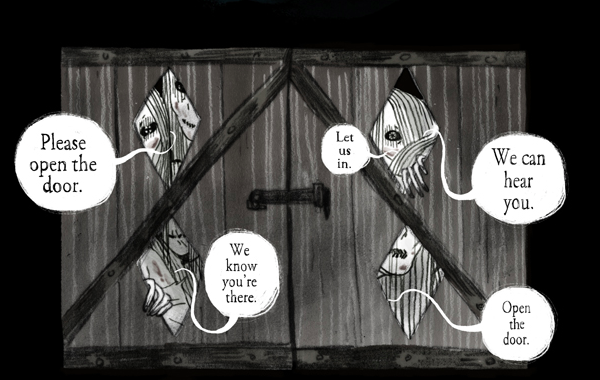
Screen Shot 2015-01-14 at 7.58.21 PMI have a raging girl crush on Canadian artist and writer Emily Carroll. She has single-handedly shown me that graphic novels and webcomics aren’t just for boys in love with guns. Sure, her comics are violent, but not in the POW! BANG! way of vintage superheroes and their incompetent nemeses. Carroll’s stories are violent in a slow, creeping way. They are dark and twisted, like the original Grimm’s fairytales (nothing like that sanitized Disney junk).

She writes fables and horror stories, fairytales and mysteries, and illustrates them beautifully. There is a layer of mistiness to each image, a sense of distance, a gray wash that only enhances the shock of crimson that comes later (sometimes it’s blood, but sometimes the horror is something else entirely).

Screen Shot 2015-01-14 at 8.09.41 PMI had my own little Christmas book flood this year (or in Icelandic, Jolabokaflod) and one of the books I received was Through The Woods, a print collection of Carroll’s webcomics and stories. Some of these are available to read online, including “His Face All Red,” a fantastic story of two brothers and a wolf, and “Out of Skin,” which is about a crone who finds herself suffocating in human skin. They’re spooky and wonderful—wholly original fairytales that pay tribute to the history the genre without being beholden to it.

Go read them on her site, or better yet, buy a copy of her book. It’s the kind of heavy book that keeps you coming back to it (I’ve read it twice already). Despite containing relatively few words, it is captivating in a literary sense and in a can’t-look-away-can’t-look-at-it sense. Also, I’ve realized that graphic novels are great because they make me slow way down and pay attention to exactly what I’m looking at. You can’t rush through them. You have to read the pictures, to pause and look at them, to suss out the clues buried within each pen stroke.

In Norway they call it Friluftsliv; in Maine we call it everyday life.

Ken Douglas Norway 2My love for all things Scandinavian continues with the word friluftsliv. What is that unpronounceable string of syllables, you ask? It’s a Norwegian concept, and there is no direct translation in the English language for what it means (in case you want to drop it into conversation, it’s pronounced free-loofts-liv). But anyone who lives in Maine will recognize the feeling—it’s that sense of being connected to nature, of feeling part of the greater world, of being outdoors and breathing the air, knowing that with each breath you are taking the exhalation of trees and droplets of lake water and even the matter of mountains into your lungs. Ken Douglas NorwayOkay, I’m editorializing a bit. Friluftsliv means “free air life” or “open air living” and it is similar to the concept of allemannsretten, which literally means “all men’s right” but is often translated as “freedom to roam.” (Did you know you can camp on anyone’s land in Norway, so long as you’re a certain distance from buildings? Free roaming for all!) Coined relatively recently, in 1859 by poet Henrik Ibsen, friluftsliv is a way of living that brings us into close contact with the great outdoors. It’s about connecting with nature, living in harmony with the green things that grow around us. Like the Danish concept of Hygge, frilutsliv provides another barometer for happiness—an alternative way of approaching harsh winters. Don’t hibernate—celebrate!

Scandinavian culture is so fascinating, and the longer I live in Maine, the more I appreciate their cold-weather wisdom.

Read more about this untranslatable word at Mother Nature Network (there’s also a short documentary at the link, which is great for procrastinating/feeding your wanderlust).

Images by Ken Douglas.

A very merry approach to death. 

merry cIn Romania, there is a place called the “merry cemetery” or in Romanian, Cimitirul Vesel  (cimitirul=cemetery; vesel=joyful, jolly). In the place of tombstones with their solid, solemn permanence, the Merry Cemetery uses wooden crosses, made from oak and painted by local artist Stan Ioan Pătraş, who started the tradition in 1935. (Since his death, his apprentices and followers have kept it alive. Now the graveyard has over 900 crosses, all decorated in the same bold style). Each headstone tells the story of the person buried beneath it, but not in the usual “here lies beloved Mary, wife, mother, and churchgoer” format. No, instead of providing brief, impersonal sketches of the departed’s life, these crosses are decorated with irreverent poems that focus on the follies and foibles of the dead, the colorful details that, in a more staid and stoic society, would cause the corpses beneath to roll over in shock.

This is, I think, the most interesting thing about the Merry Cemetery—aside from the folk art paintings and the striking cerulean hues. This is a place where death is allowed to be funny, even joyful. The dead don’t lose their personalities; instead of being placed beneath bland and anonymous pieces of granite, the dead lie below brightly colored tributes to their idiosyncrasies. A critical mother-in-law is remembered in a rhyming epitaph for her sharp words and wit. A known womanizer is immortalized for his favorite vice. (“Ioan Toaderu loved horses,” reads his headstone, “One more thing he loved very much / to sit at a table in a bar / next to someone else’s wife.” I believe it rhymes in Romanian.)

merryc2I’m afraid of too many things, which is perhaps why I love this approach to death. It seems natural and human. Consoling, in that strange way (I think dark humor is comforting, even when it’s a bit terrible and offensive—it takes the sting away from real terrors). The moment I saw images from the Merry Cemetery, I remembered a book I once read about Frida Kahlo that describes the artist’s feelings about death. Obviously, the visuals call to mind Mexico’s Day of the Dead, with its sugar skulls and dancing skeletons, but I think the resemblance goes even deeper than that. According to this book, Kahlo saw her death as a figure that was always close, always waiting for her, a thing that loved her, and wanted to see her home. It was her skeletal shadow. If you look at death like this, like Kahlo did and perhaps some Romanian artists do—death isn’t the enemy. Just a friend that you don’t want to meet right now.

Images via Flickr here & here.

Grimm plus Gorey equals macabre fairytale perfection.

grimmgorey
Edward Gorey once illustrated classic fairytales from The Brothers Grimm, retold in sparse but humorous language by author James Donnelly. How did I not know this?!? What a perfect combination. If I had a kid, I would buy this for them straightaway. rumpelstiltskinIn case you couldn’t tell, the top picture shows Little Red Riding Hood meeting that big, bad wolf in the forest before it runs off to do some mild cross-dressing. The second picture is Rumpelstiltskin, that little gnome-y scoundrel, dancing in the forest and celebrating the victory that will never be his.

Buy the book here.

“You are the only custodian of your own integrity.”

Screen Shot 2015-01-10 at 10.12.15 AMBrain Pickings is one of my all-time favorite websites. It’s a thoughtfully curated selection of intellectual inspiration and bookwormy quotes. The woman who runs it, Maria Popova, who describes the site this way: “The core ethos behind Brain Pickings is that creativity is a combinatorial force: it’s our ability to tap into our mental pool of resources — knowledge, insight, information, inspiration, and all the fragments populating our minds — that we’ve accumulated over the years just by being present and alive and awake to the world, and to combine them in extraordinary new ways.” So good, right?

Naturally, Popova has accumulated quite a bit of knowledge in her years of running the site. In 2013, to celebrate seven years of pickin’ brains, she published a short essay on seven things she learned. It’s a lovely little meditation on how to generously give your time while protecting your own integrity, how to respect yourself and others, and why changing your mind is an important part of being human. Now, the fundamental points of this piece have been made into a sweet animated video. It is the greatest way to start a Saturday—some gentle music, some inspiration, and a reminder that slowing down and doing nothing at all is sometimes necessary. Vital even. It gives our brains time to be creative, space to play with new thoughts. I tend to think of my best story ideas in the shower. I think it’s partially due to the water (few things make me feel creative or light or good or strong like water on my body) but it’s also because showering is metal downtime, when I have nothing to do but let the drops wash over me and think, quietly and unfocused, open and without purpose.

I’m getting sidetracked! Go watch the video. Then go create things. Or do nothing. It’s Saturday, after all.

Here’s to finding sparkles.

muchaThis year, instead of making resolutions, I decided to think about who has inspired me in 2014. I have a bad tendency to compare myself to others, and it usually makes me feel horrible, lacking in some way. But it doesn’t have to! When I slow down and think about the people I love, and the traits I admire in them, I don’t feel lacking. I feel lucky. Lucky to know them. Lucky to learn from them.

Here are just a few people who inspired me in 2014. Every year, I resolve to be braver, to be kinder. This year, I want to be brave, kind, compassionate, ambitious, creative, and to see the sparkles that light up every day.

Continue reading

Moki, teach me how to disappear.

Screen Shot 2015-01-07 at 10.22.37 PMI just spent an hour tracking down the origins of this piece. I first saw the eerily calm, untitled image floating around on Pinterest. It’s by Berlin-based artist Moki, and oh man am I glad I figured that out. Because Moki is amazing. This waterfall sleeper is from the series “How to Disappear,” a name that feels like it was plucked from somewhere inside my ribcage. Her work is amazing—soft, textured, dreamlike. She’s also chosen to remain anonymous, painting under the simple nickname Moki, keeping her real identity hidden. Disappear? She’s already invisible. Screen Shot 2015-01-07 at 10.25.27 PM On her website, she has several other projects, like “Turquoise” and “Caves” and even a series on treehouses. All her work seems to touch on similar themes and swim in that weird place of magical realism. (I know in art it’s called surrealism… but the tone of these images seem closer to a page from a novel—they lack the flatness that so many surrealist images have. They are so layered and human. They tell stories. Damn, even that rock looks human.)  Screen Shot 2015-01-07 at 10.26.54 PMScreen Shot 2015-01-07 at 10.26.41 PMScreen Shot 2015-01-07 at 10.26.21 PMSo lovely. See more here.

Eat radical: Inside Vinland, the only 100-percent local restaurant in the world (located here in Maine!)

Screen Shot 2015-01-05 at 12.27.16 PM

In Portland, farm-to-table restaurants with eat-local missions are more common than a pair of Bean Boots. So perhaps it was inevitable that our neighbors to the north would push the concept even further. Chef David Levi’s passion project, Vinland, which turns one this month, features 100 percent locally sourced ingredients—which means that citrus, black pepper, and olive oil are all banned. With the exception of wine and coffee, everything used at Vinland comes from Maine.

I had a wonderful time hanging out with chef David Levi for this article, which was just published in the January issue of Boston Magazine. I really love writing about food—almost as much as I love eating it. That turnip soup? It’s fantastic. Tangy, rich, comforting, fresh, so good (no wonder it’s Levi’s signature dish). Read the full piece here. 

Photographs by the amazing Greta Rybus

Herbal cures for whatever ails you.

Screen Shot 2015-01-05 at 11.59.36 AM
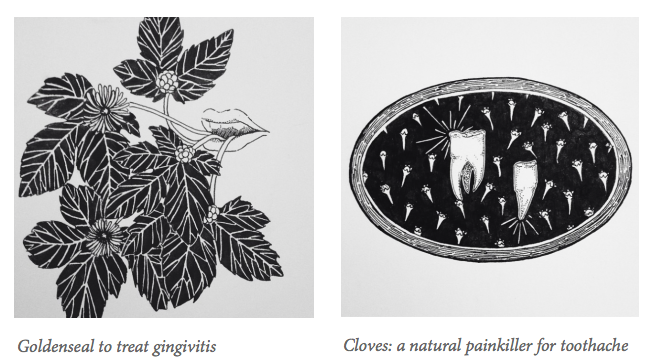
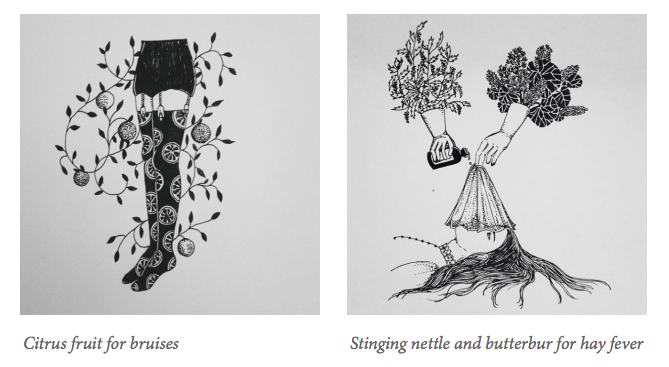
Blogger and artist Catherine of Wolf Eyebrows took to Instagram this summer for a 30 days project in which she sketched medical ailments and their natural remedies. The results are just great—albeit a little bit gross. But I don’t find that off-putting. There is so much humor in each pretty little sketch!

Screen Shot 2015-01-05 at 12.02.59 PM
On a related note, I’m learning how to make herbal tinctures. I’ve dabbled in foraging—though who in Maine hasn’t gone out looking for fiddleheads? It’s practically a rite of spring—but herbal medicine is new to me. I love the idea that we can cure ourselves with leaves and petals and roots rather than pills and needles and plastic. Admittedly, that idea is particularly attractive at the moment, seeing as I don’t have health insurance, but there’s something deeply appealing to this highly independent, mildly prickly lady about being able to fix my damn own body without calling for help.

See the full project here.