Why I read, why I write.

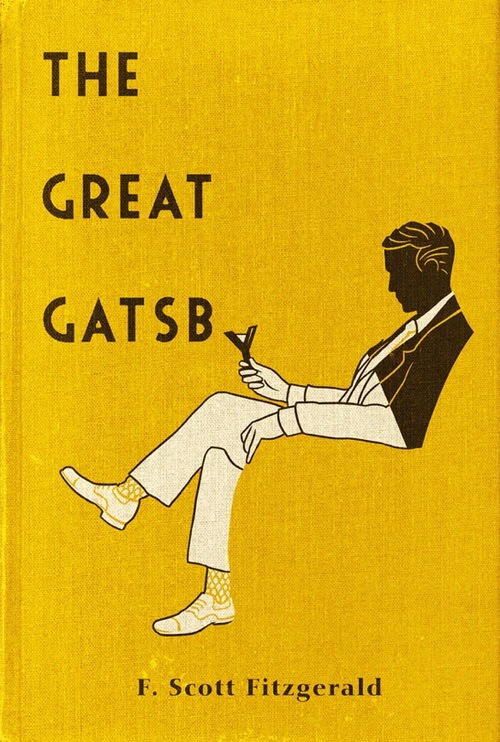
gatsby-cover“F. Scott Fitzgerald writes the best sentences out of any author, ever,” said my incredibly passionate, delightfully nerdy high school English teacher. At the time, I didn’t even think to disagree. Fitzgerald’s sentences were so intricate, so smart, so filled with detail and beauty, that I couldn’t imagine liking anything more. It was a time when The Great Gatsby epitomized literary perfection (at least, it did for me) and there was nothing more appealing than being one of The Beautiful and The Damned. While his books included very little sex, at least by modern standards, they were sexy in a way that appealed to my angst-ridden 16-year-old self. Fitzgerald’s ladies were wilting and lovely, brilliant but dulled by too much champagne. Glittery and full of spark, yet oppressed and exhausted by everything. I think that’s what I wanted to be: beautifully, gracefully, electrically exhausted.

Now, I like to think I know better. I no longer read his short stories and novels searching for a shadow of myself. But I will always admire his sentences. Who else can craft that kind of sentence, that speaks infinities with a single dependent clause, that opens new worlds of thoughts with a well-placed bit of punctuation?

Here to answer my question is a roundup by The American Scholar. I came to this list from an NPR story I only half heard, and I didn’t quite know what to expect when I dug up the article and clicked the link. Things are not often exactly what I expect (they’re usually a little more, and equally often, a whole lot less) but this is. From the first chosen sentence, a passage from (where else?) The Great Gatsby, to the last, an atrociously cruel Nabokov quote, it’s a wonderful reminder of why I love to read. I love to read because Toni Morrison can write things like this: “It was a fine cry—loud and long—but it had no bottom and it had no top, just circles and circles of sorrow.” I love to read because Joan Didion can at once awaken my cynicism and send a shiver down my spine as easy as this: “It was the United States of America in the cold late spring of 1967, and the market was steady and the G.N.P. high and a great many articulate people seemed to have a sense of high social purpose and it might have been a spring of brave hopes and national promise, but it was not, and more and more people had the uneasy apprehension that it was not.”

I love to read because it reminds me of my own capacity to wonder.

Its vanished trees, the trees that had made way for Gatsby’s house, had once pandered in whispers to the last and greatest of all human dreams; for a transitory enchanted moment man must have held his breath in the presence of this continent, compelled into an aesthetic contemplation he neither understood nor desired, face to face for the last time in history with something commensurate to his capacity for wonder.

– F. Scott Fitzgerald, The Great Gatsby
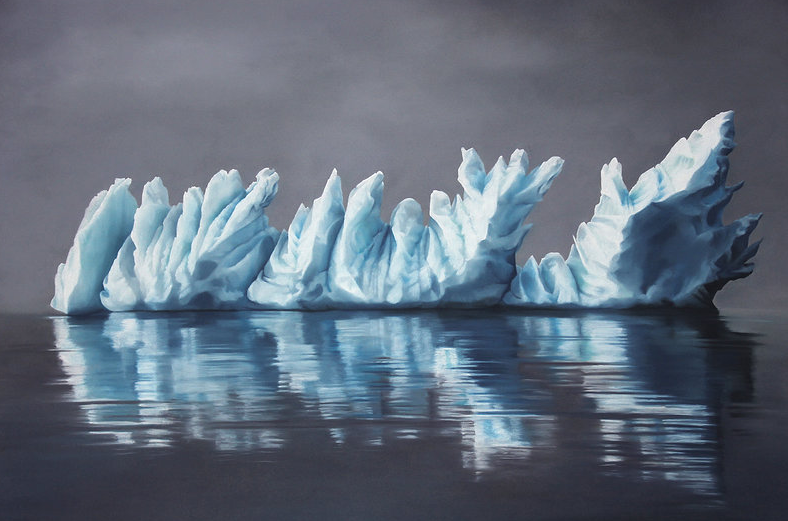
Art of the far north: Zaria Forman’s Greenland farewell.

Screen Shot 2014-03-16 at 6.15.39 PMIt’s been a long, difficult winter. Frigid and unrelenting. Bitter cold in a way that feels almost violating, seeping under my clothes and into my skin, settling in my bones and turning those elegant calcified shapes into fragile pieces of ice, ready to shatter at a moments notice.

To be clear, I’m not a fan of winter.

But I am very much in love with Zaria Forman’s series of drawings, “Greenland: Chasing the Ice.” In August 2012, she lead an arctic expedition for the purposes of capturing the icy landscape in art. Inspired by her mother’s desire to head north, Zaria struck out on history’s second trip with this goal (the first was in 1869, led by the American painter William Bradford). Tragically, though Zaria’s mother was instrumental in planning the expedition, she didn’t live to see it through. “Documenting climate change, the work addresses the concept of saying goodbye on scales both global and personal,” Zaria writes. “In Greenland, I scattered my mother’s ashes amidst the melting ice.”

Whoa, right? It’s big, heavy, sad, lovely work. And the drawings, as you might have noticed, are stunning. Zaria also traveled to Svalbard (a peninsula at the northern tip of Sweden) and produced many drawings based on that experience. Her work is amazing. Delicate, detailed, but so, so cold. It makes me shiver to look at it.

Check it out here.


Building my own damn house.

onwardThere’s a moment when one is pushed back upon oneself. Forced to encounter something uncomfortable, something we wish wasn’t there. It’s a sticky, painful feeling, like touching an open wound and feeling the sick yellow substance that creeps atop scabs. It’s like turning around suddenly and finding a mirror behind you. Lurking and angry, ready to reveal more than you ever wanted to know.

I try, for the most part, to be comfortable with discomfort. It’s such a weak word, anyway, “comfortable.” A pillow is comfortable. A pair of slippers. A person should never be comfortable. I’m not an armchair or a pair of boots. I’m a spiky thing, with sharp edges and rotten black parts and sweet soft spots and an entire map of love and pain and mess in between.

All that said, I’ve been thinking a lot about writing. When I’m writing, I’m in touch with that messiness, that place that feels familiar, yet foreign. It creates a bulwark for the sudden approach of that awful mirror. That shining thing that pretends to tell the truth, demands so much, and gives so little in return (terrible things, mirrors!).  Writing is a way to lay bricks down, to build, piece by piece, a defense against that shallow reflection. It’s a house I want. My own damn house. A place of bricks and hard work, a place where mirrors are only that—glossy, flat, lifeless mirrors.

Building that house is hard though. And that’s why I’m going to get back to this, to writing. I can’t promise it will be daily, but damn, I hope so. Blogward and upward!

Myriam Dion is destroying print media.

anthology-mag-blog-Cut-Paper-by-Myriam-Dion-2As much as it pains me to admit this, I know, at some point in my life, I said the phrase “print media is dead.” It was probably when I was fresh out of college and working exclusively online and intoxicated by the sweet poetry of HTML and distracted by the truly catholic offerings of my most beloved blogs. I probably thought I was just being practical. I probably thought I was right (because I usually do think that, sometimes even for far longer than I honestly should).

But print is not dead! Print is alive and wonderful and fun, and learning about things like page bleed and grammage has been surprisingly fascinating. Paper is a cool thing, in and of itself, but Myriam Dion makes it extra, excruciatingly cool. This Canadian artist turns newsprint into art, thus destroying the original object’s functionality while creating something that is far more beautiful than the paper itself. And she does this by cutting, slicing, and peeling out slivers of the pulpy-soft weave. With Dion’s pieces, print is both alive and dead. And I love it.

See more at Anthology Mag.

Girls.

nz-10I’ve been thinking a lot lately about the friendships that form between girls. As a kid, I always had just one best friend. I tended to have these incredibly close, very intense relationships with just a single person. I guess you could say my serial monogamy began back in grade school, because as an adult, I do the same thing with men.

I think I’ve always been drawn to the intimacy that can arise between a pair of two—especially between two girls. For years, the most important relationship in my life was with a friend named Sara. We spent every free moment together; we held hands, we called each other every night; we talked alike and acted alike. We were eventually voted “Dynamic Duo” in our high school yearbook. Even now, when fiances and boyfriends have become our Significant Others, we remain close. But the giddiness, the head-tingling pleasure of whispering secrets, the sweet feeling of acceptance—all that is something I will always link to childhood. To late night sleepovers and days spent passing notes, written in glitter pen, folded with intricate origami, and written in the secret language that passes between middle school girls.

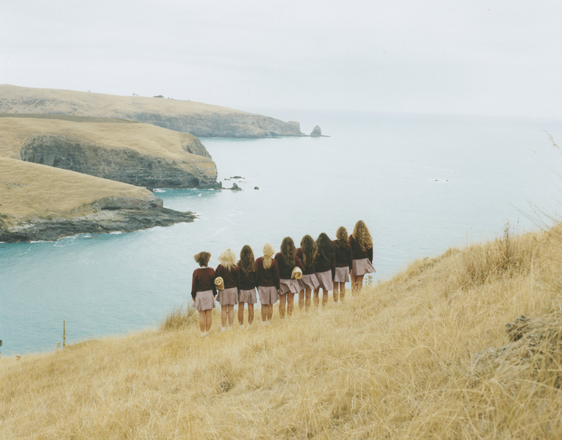
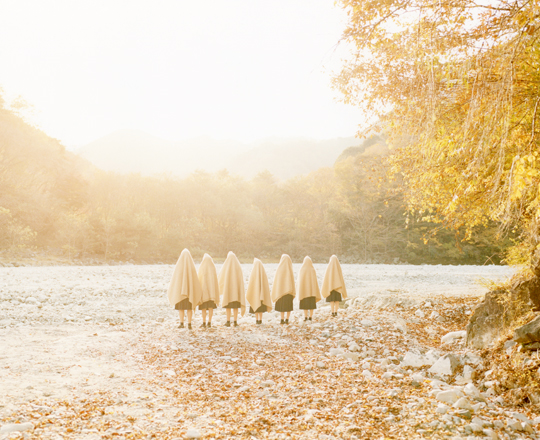
While her photographs don’t depict groups of two, Osamu Yokonami’s series of schoolgirl portraits remind me of that strange, almost mystical feeling of becoming so very, very close with another person. There is nothing sexual about it, but in some ways, that makes it even more intense; it’s wanting to be someone, to inhabit the same space, to have an identity that is somehow more than yourself, yet lighter, more diaphanous, full of sweetness and light and air.
as9
Dressed in uniform, these girls are seen from a distance. At this range, they all look the same. They could have come out of the same wooden doll, little matryoshkas walking one by one across a snowy field. They could be dolls or demons. They meld together, these girls.
ase03
The entire series is gorgeous, as is all Yokonami’s work. There is a dreamy quality to it that reminds me of old photographs, shot with clunky cameras and developed in dark rooms. See what I mean, here.

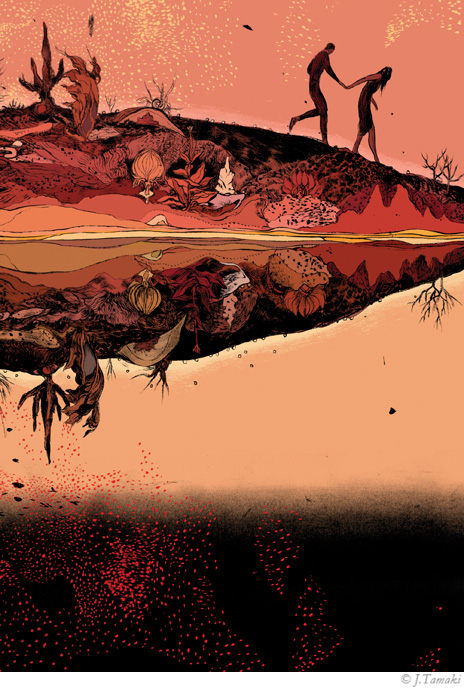
Jillian Tamaki makes myths come alive.

Screen shot 2013-08-12 at 7.59.28 PMI have always been drawn to myths and legends above all other forms of storytelling. They’re the oldest answers to all of our questions. They speak to people across cultures and generations. They say something vital, strange, and deep about what it is to be human. They are in our blood, deep within our veins, moving like so many slow growing roots, connecting us to our most primal fears, most archaic yearnings.

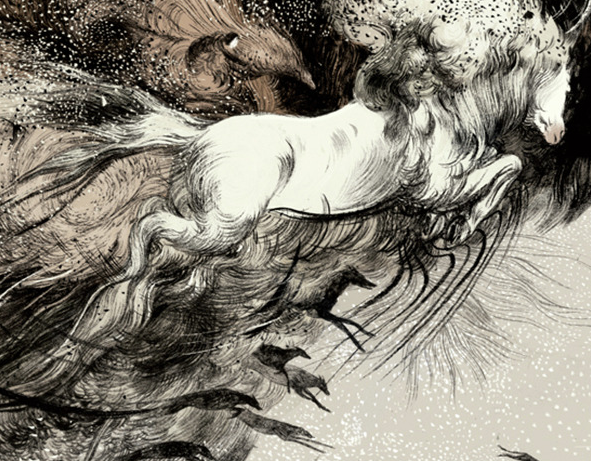
Over and over, artists have tried to capture the otherworldly nature of these stories, and I never get sick of seeing them. But these images, by illustrator Jillian Tamaki, strike a powerful chord in me. Her style is both precise and free-flowing. Shadows of horses rush from a dark cloud, swans beat their wings into a frenzy of feathers. The style reminds me of woodblocks, but there is something wonderfully modern about each piece.

irishmythsandlegends_tamaki8In addition to this series, which was created for a new printing of Irish Myths and Legends (available through The Folio Society), Tamaki has worked on several more mundane projects. But though they may be company commissioned, her talent elevates even ads.

See more here.

{Via}

Maine-made prints.

Hummingbird TriptychI don’t highlight Maine-based artists nearly enough on my blog, especially considering how much awesome talent is hidden away in our corner of the country. Including Josh Brill, the artist behind Lumadessa. He makes these fantastic geometric animal prints that I totally adore. While his shop has many colorful avian prints—including a stately blue jay and a pretty little cardinal—I particularly like the jungle animals. Made of stripes and blocks and other hard shapes, they are surprisingly light and sweet.
Screen shot 2013-07-02 at 9.09.06 PMIn unrelated news, I just finished reading Life of Pi. I expected to love it, and I didn’t. But I did close the book with a new appreciation for zookeepers. I’ve still never been to a zoo (an odd never-have-I-ever fact), and I’m not convinced I should ever go to one, but there is something to be said about animals loving their routines. I know my dog loves her simple life.

Anyway, if you want to buy one of Josh’s prints, you can do so here. 1% of profits go to animal and environmental charities, a fact that makes me feel mildly better about possibly purchasing yet another quirky, unframed print. I really need to find some good, cheap frames…

Bright white, true blue: the MFA exhibits my favorite colors.

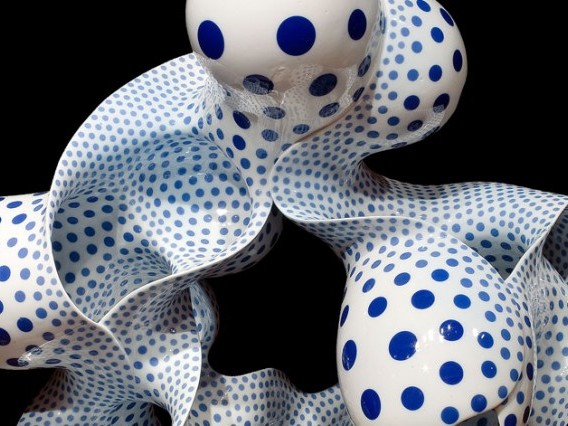
blueandwhiteIt’s not often that I wish I was back in Boston, but this exhibit at the Museum of Fine Arts has me planning a trip down south: “Blue and White,” on show at the Henry and Lois Foster Gallery. Blue and white ceramics are such a familiar sight, but this show takes the traditional color palate and somewhat rigid medium and twists it, transforming the formula. From what I’ve seen online, the pieces echo earlier work in a playful, irreverent way. Plates are painted with unexpected scenes, impressionist brushstrokes dance across porcelain, and polka dots lend a youthful quality to a fluid sculpture with a möbius strip-like complexity.
Screen shot 2013-07-02 at 8.56.43 PMHow fun, right? Sadly, it’s only on view for a few more days… so I probably won’t make it there. What a bummer.

[MFA Boston]

Carly Waito has me craving rocks.

Screen shot 2013-06-23 at 11.14.53 PM
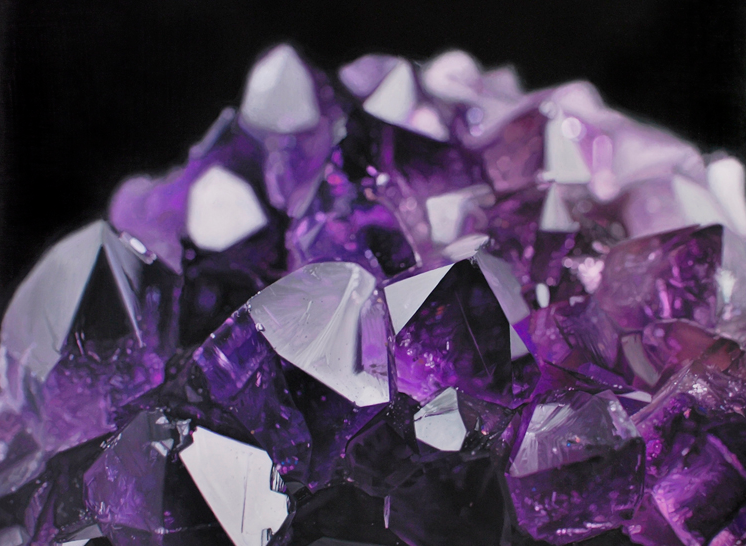
Some kids, my teacher friends have told me, feel the need to put everything in their mouths. “I don’t get it! Why would you eat that?” they say, wondering about glue, crayons, chalk, and other, more sinister science-experiment materials. I act like I’m confused, too, but I get it. I was one of those kids, who needed to lick objects, to smell and taste each thing. I was a kid who ate chalk and dirt and took rocks from the beach, smoothed by the sea and flavored with salt, and hid them in my mouth like candies.

Is this gross? Maybe, but I remember a fair number of paste-eating kids from my childhood. I think most of us grew out of it, but for whatever reason, I still want to lick these paintings by Carly Waito.

Screen shot 2013-06-23 at 11.14.40 PM

Yes, they are paintings! I know, they look just like photographs. It takes some serious skill to render geodes and rocks in such exquisite detail. Lately, I’ve found myself drawn to hyper-realistic painters. My dad is a big fan of James Aponovich, and so several years ago, he bought me a poster. It’s a still life, and it’s very realistic, two things I don’t always go for, and yet somehow it has survived my schizophrenic apartment hopping and remained on my walls. More and more, I find myself appreciating artists who give their work that weird lickable, slick quality. Even as they approach perfection, even as they verge into photographic likeness, there is always a certain element that keeps it from being quite perfect. Is that cruel to say? I hope Waito isn’t striving for perfection. I rather like what she’s doing now.

Fong Qi Wei blows up blossoms.

Rose Exploded 01, SingaporeIf you ask my boyfriend, who is a biologist by trade and botanist by passion, he will tell you all about the sex lives of plants. Pistols and stamens and pollen—oh, my! It’s some seriously dirty stuff. I think photographer Fong Qi Wei gets that. His flowers are exploding with joy, bursting with happiness and color and light. His photographs are a psychedelic exercise in neatness. Paradoxical? Perhaps, but I don’t care.
Sunflower Exploded 01, SingaporeSee more here.
{via Laughing Squid}