Social media mysticism & let’s say a big welcome to spring, dirty though she may be.

Black tailed jack rabbitFour days late: Rabbit, rabbit, rabbit.

Did you know that the tradition of saying “rabbit rabbit” on the first of the month (or in the UK, “white rabbit” or even “bunny, bunny”) is a relatively new bit of folkloric superstition? This odd habit first appeared in the early 1900’s (FDR was a rabbit-rabbit devotee and reportedly uttered the silly phrase on the first of the month without fail). No one really knows where it came from or why the magic words vary from place to place. Most people think it has something to do with the tradition of carrying a dead rabbit’s foot on a keychain—another thing FDR was known to do. I suspect that the tradition is becoming even more widespread in the age of Facebook and Twitter, where everyone can digitally rabbit rabbit for good luck. Or just to show that you’re well versed in social media mysticism. (This is either the best kind of hoodoo or the very worst. I don’t really know.)

In America, rabbit-ing is a New England thing, and I rather like that. New Englanders always seem like such skeptical, cold folk. It’s nice to know that we’re also pulled toward the rabbit hole of nonsense (because if there is anything truly magical, that’s where it hides: in plain sight under piles of nonsense).

But I suppose I am thankful that it’s finally spring. The ground has turned to mud. Everything is coated in grime. Portland is a city of dirt and muck. Even the whitest of rabbits would turn hare-brown here. Wild, like a Dürer.

How writing is like catching fish & what Rilke said.

Illustration by Elisa Ancori

Things aren’t all so tangible and sayable as people would usually have us believe; most experiences are unsayable, they happen in a space that no word has ever entered, and more unsayable than all other things are works of art, those mysterious existences, whose life endures beside our own small, transitory life. – Rainer Maria Rilke

I caught a fish with my hands once. It was swimming upstream to spawn in the thaw of spring, which in Maine means mid-May (we don’t have a pretty, dappled ascent into summer, just a mess of thawing ice and a long, painful mud-season that only plays at warmth). Every now and then, a trout would fly out of the river as it tried to make its way up the waterfall, a little flash of black and silver in the air, improbable as a proverb.

I was with a park ranger, and he told me to try and catch one. I waded out into the water across slippery stones. It was so, so cold against my bare feet and ankles. It took a few tries to catch a fish. I would see it coming, watch downstream as it approached, and plunge my hands into the water, groping blindly in the bubbles and blackness. I felt so many fish swim deftly between, around, over my hands. In the end, I crouched down with my numb hands motionless in the water, ready for the trout to come to me. Eventually, one did.

I held it over my head and my friend on the riverbank took a picture. I remember feeling so powerful, as though I had accomplished something far bigger than grabbing a dumb creature out of a river. Then I set the fish back into the water and let it continue its upstream swim, struggling against the current, driven by instinct and desire, rushing toward its chance to mate.

I’m writing this because I can’t write anything else right now. I am smothered by winter and anxiety. And when I read that Rilke quote, all I could think of was that fish. Experience is as slippery and elusive as a fish, evading all attempts to pin it down with language, though that is the job of the writer, isn’t it? To catch the fish. To say something real with the clumsy, numb tools we have.

Spring’s thaw can’t come soon enough.

Above quote by Rilke, image by Barcelona-based artist Elisa Ancori

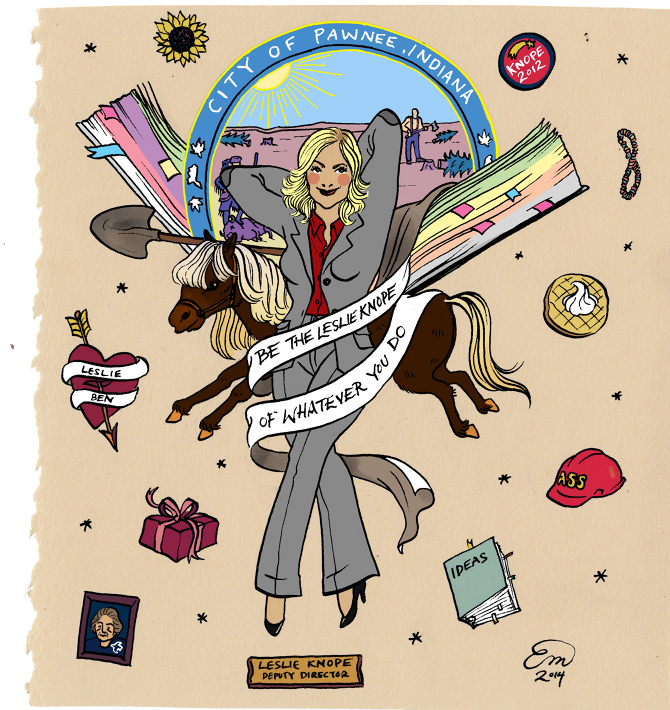
Be the Leslie.

Be Leslie Knope Illustration by Emma MungerIn honor of International Women’s Day, here’s a badass illustration of Leslie Knope of Parks and Recreation (quite possibly my favorite TV show of all time) by California artist Emma Munger. This is my new goal: To be the hardest working, most dependable, best writer I can possibly be. To fail sometimes, but to keep at it. To succeed in the end through kindness and sheer determination (and smarts, too. Leslie is whip-smart despite her many malapropisms and general fuck-ups).

Emma Munger is also responsible for a very cool illustration tracking the wanderings of Wolf OR-7—the first wolf seen in California since 1924! Like Leslie Knope, wolves are badass and awesome. And probably feminists. I bet they are.

I love puns, portmanteaus, and plants.

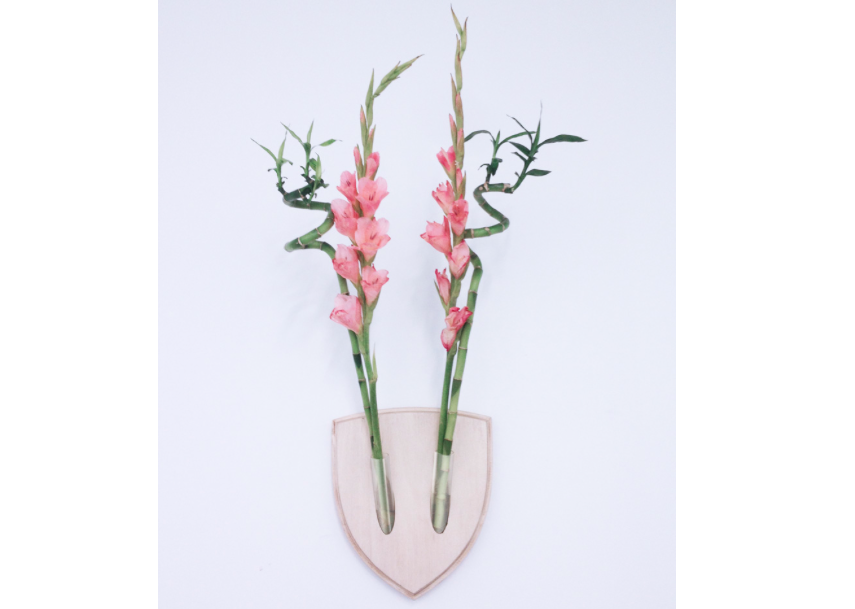
Screen Shot 2015-02-18 at 3.59.12 PMElkebana is a portmanteau of ikebana, the Japanese art of flower arranging, and elk, the animal with the big antlers that people like to kill and stuff and put on exhibit. It’s also a very clever name for a very clever product. Twin vases mounted on wood let you display blossoms like others display heads—hanging from the wall, living (though soon to be dead). I love this. Screen Shot 2015-02-18 at 4.05.34 PMOrdering info is here. It would also be a pretty simple DIY, but kudos to designers Fabio Milito & Paula Studio for coming up with such a rad concept.

When a lobster whistles on top of a mountain.

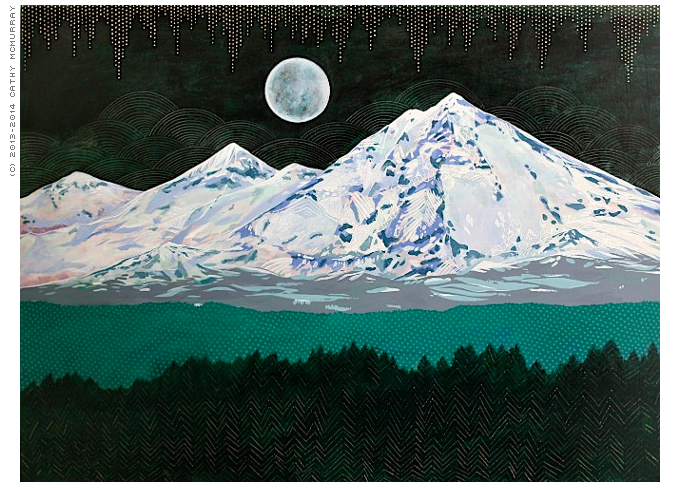
Three Peaks by Cathy McMurray

Idiom:ชาติหน้าตอนบ่าย ๆ
Literal translation: “One afternoon in your next reincarnation.”
What it means: “It’s never gonna happen.”
Other languages this idiom exists in: A phrase that means a similar thing in English: “When pigs fly.” In French, the same idea is conveyed by the phrase, “when hens have teeth (quand les poules auront des dents).” In Russian, it’s the intriguing phrase, “When a lobster whistles on top of a mountain (Когда рак на горе свистнет).” And in Dutch, it’s “When the cows are dancing on the ice (Als de koeien op het ijs dansen).”

The folks at the TED Talks blog went around asking translators what their favorite idioms were from other cultures. The results are awesome. It’s also interesting to see how many of them use animal imagery. The idioms from Japan are almost all about cats. (For instance, “cat’s forehead” is a very small space, often used to describe one’s property in self-deprecating terms. I might start using this one.) Many of them are about wolves, because, I suppose, wolves were a real issue in medieval Europe (or so picture books would have me believe). I love the Russian ones the best, I think, and the Slavic ones. I could see “when a lobster whistles on top of a mountain” catching on pretty easily in Maine, seeing as we have a lot of lobsters and some pretty gorgeous mountains.

Speaking of mountains, the picture above is actually of the other coast by Portland-based (again, other Portland) artist Cathy McMurray. I am completely in love with her style—the big blocks of color mixed with intricate, repetitive detail—and I actually own a few of her prints. Go check her out here.

Skeletons of saints, covered in gems.

- Waldsassen, Germany, detail of St. Gratian. The Basilika at Waldsassen holds the largest extent collection of presumed skeletons of martyrs from the Roman Catacombs still on display..

When a man in a German village approached Paul Koudounaris during a 2008 research trip and asked something along the lines of, “Are you interested in seeing a dilapidated old church in the forest with a skeleton standing there covered in jewels and holding a cup of blood in his left hand like he’s offering you a toast?” Koudounaris’ answer was, “Yes, of course.”

I’ve been waiting my entire life for someone to ask me that question! Preferably an old crone with chicken feet that poke from beneath her skirt. She’ll ask me to come with her in cackling tones, then she’ll lower her voice and lean forward. “My name is Baba Yaga,” she will whisper, her breath smelling of burnt sage and rotting meat. “I know,” I’ll say. “I’ve been waiting for you.” She will nod, folds of her red calico headscarf falling around her wrinkled face and glinting eyes. “Come with me, child. Into the forest.”Screen Shot 2015-01-30 at 7.10.23 PM

But dang, some people have all the luck. Koudounaris is a photographer, author, and art historian. He has a really rad website called Empire de la Mort that you can check out here. For a more intellectual take on his work, go read the piece at Smithsonian.com.

History of Pretty: Albrecht Dürer, the reason I studied art history in the first place.

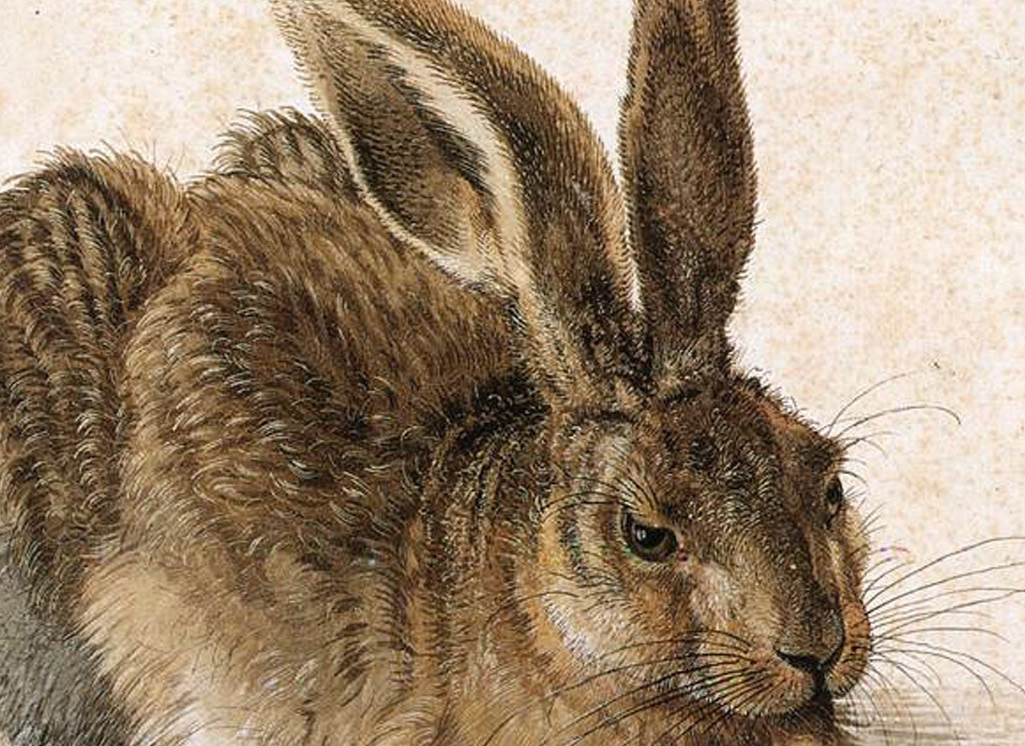
durer-a-young-hareThis watercolor paintings, Dürer’s “Young Hare” (or in German, Feldhase), is one of my all-time favorite pieces of art. Painted in 1502, this image is iconic for its insane level of detail. Can you believe that picture is only approximately eight inches wide? Yet somehow, Dürer, that master of precision, was able to create a lifelike image, complete with hair that goes this way and that, and lovely golden undertones that gives the wild rabbit warm vibes.

Let’s get a bit closer: durer detailThat bunny looks a little mean, if I’m being totally honest. Or perhaps mean isn’t the right word—feral. Wild. But still, I would love to stroke its fur. Continue reading

Tapestry taxidermy

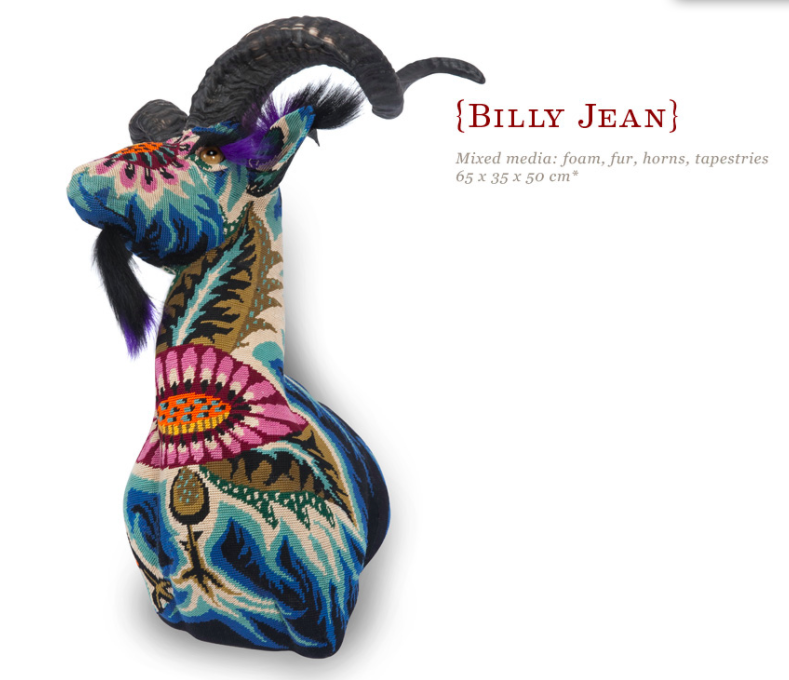
Screen Shot 2015-01-20 at 1.02.41 PMToday was incredibly long and not particularly enjoyable. So, I don’t have anything to say really about these tapestry “taxidermy” creatures except wow. So pretty, so clever. Screen Shot 2015-01-20 at 1.03.32 PMThe lady who makes them is tres jolietoo. (Of course she is; she’s French and perfectly disheveled. Women like Frederique are the entire reason I’ve had bangs for the past twelve years.) Screen Shot 2015-01-21 at 10.49.01 PM

There are lots more beautiful pictures on her website—check it out.

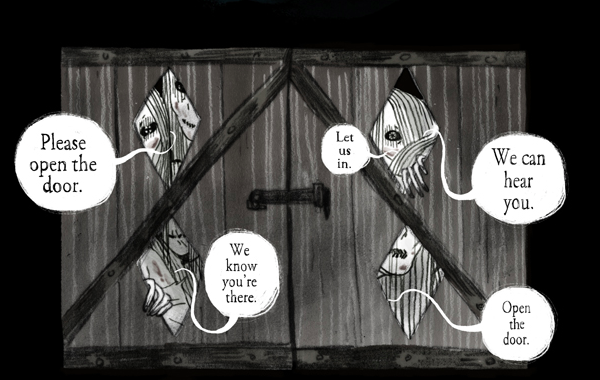
Emily Carroll gets under my skin.

Screen Shot 2015-01-14 at 7.58.21 PMI have a raging girl crush on Canadian artist and writer Emily Carroll. She has single-handedly shown me that graphic novels and webcomics aren’t just for boys in love with guns. Sure, her comics are violent, but not in the POW! BANG! way of vintage superheroes and their incompetent nemeses. Carroll’s stories are violent in a slow, creeping way. They are dark and twisted, like the original Grimm’s fairytales (nothing like that sanitized Disney junk).

She writes fables and horror stories, fairytales and mysteries, and illustrates them beautifully. There is a layer of mistiness to each image, a sense of distance, a gray wash that only enhances the shock of crimson that comes later (sometimes it’s blood, but sometimes the horror is something else entirely).

Screen Shot 2015-01-14 at 8.09.41 PMI had my own little Christmas book flood this year (or in Icelandic, Jolabokaflod) and one of the books I received was Through The Woods, a print collection of Carroll’s webcomics and stories. Some of these are available to read online, including “His Face All Red,” a fantastic story of two brothers and a wolf, and “Out of Skin,” which is about a crone who finds herself suffocating in human skin. They’re spooky and wonderful—wholly original fairytales that pay tribute to the history the genre without being beholden to it.

Go read them on her site, or better yet, buy a copy of her book. It’s the kind of heavy book that keeps you coming back to it (I’ve read it twice already). Despite containing relatively few words, it is captivating in a literary sense and in a can’t-look-away-can’t-look-at-it sense. Also, I’ve realized that graphic novels are great because they make me slow way down and pay attention to exactly what I’m looking at. You can’t rush through them. You have to read the pictures, to pause and look at them, to suss out the clues buried within each pen stroke.

A very merry approach to death. 

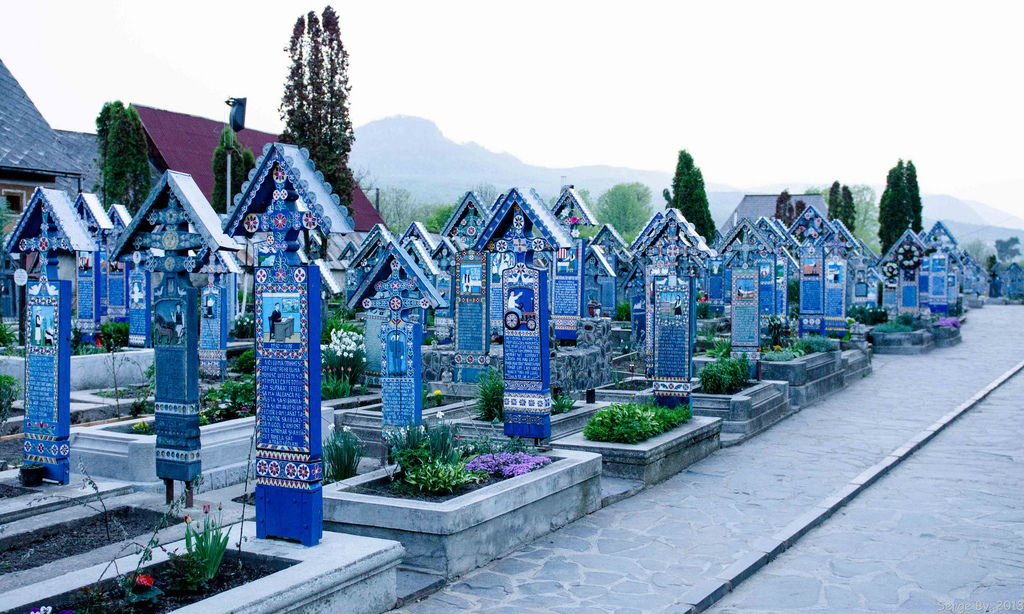
merry cIn Romania, there is a place called the “merry cemetery” or in Romanian, Cimitirul Vesel  (cimitirul=cemetery; vesel=joyful, jolly). In the place of tombstones with their solid, solemn permanence, the Merry Cemetery uses wooden crosses, made from oak and painted by local artist Stan Ioan Pătraş, who started the tradition in 1935. (Since his death, his apprentices and followers have kept it alive. Now the graveyard has over 900 crosses, all decorated in the same bold style). Each headstone tells the story of the person buried beneath it, but not in the usual “here lies beloved Mary, wife, mother, and churchgoer” format. No, instead of providing brief, impersonal sketches of the departed’s life, these crosses are decorated with irreverent poems that focus on the follies and foibles of the dead, the colorful details that, in a more staid and stoic society, would cause the corpses beneath to roll over in shock.

This is, I think, the most interesting thing about the Merry Cemetery—aside from the folk art paintings and the striking cerulean hues. This is a place where death is allowed to be funny, even joyful. The dead don’t lose their personalities; instead of being placed beneath bland and anonymous pieces of granite, the dead lie below brightly colored tributes to their idiosyncrasies. A critical mother-in-law is remembered in a rhyming epitaph for her sharp words and wit. A known womanizer is immortalized for his favorite vice. (“Ioan Toaderu loved horses,” reads his headstone, “One more thing he loved very much / to sit at a table in a bar / next to someone else’s wife.” I believe it rhymes in Romanian.)

merryc2I’m afraid of too many things, which is perhaps why I love this approach to death. It seems natural and human. Consoling, in that strange way (I think dark humor is comforting, even when it’s a bit terrible and offensive—it takes the sting away from real terrors). The moment I saw images from the Merry Cemetery, I remembered a book I once read about Frida Kahlo that describes the artist’s feelings about death. Obviously, the visuals call to mind Mexico’s Day of the Dead, with its sugar skulls and dancing skeletons, but I think the resemblance goes even deeper than that. According to this book, Kahlo saw her death as a figure that was always close, always waiting for her, a thing that loved her, and wanted to see her home. It was her skeletal shadow. If you look at death like this, like Kahlo did and perhaps some Romanian artists do—death isn’t the enemy. Just a friend that you don’t want to meet right now.

Images via Flickr here & here.